Dragon Flag: How to Do It, Muscles Worked, Progression
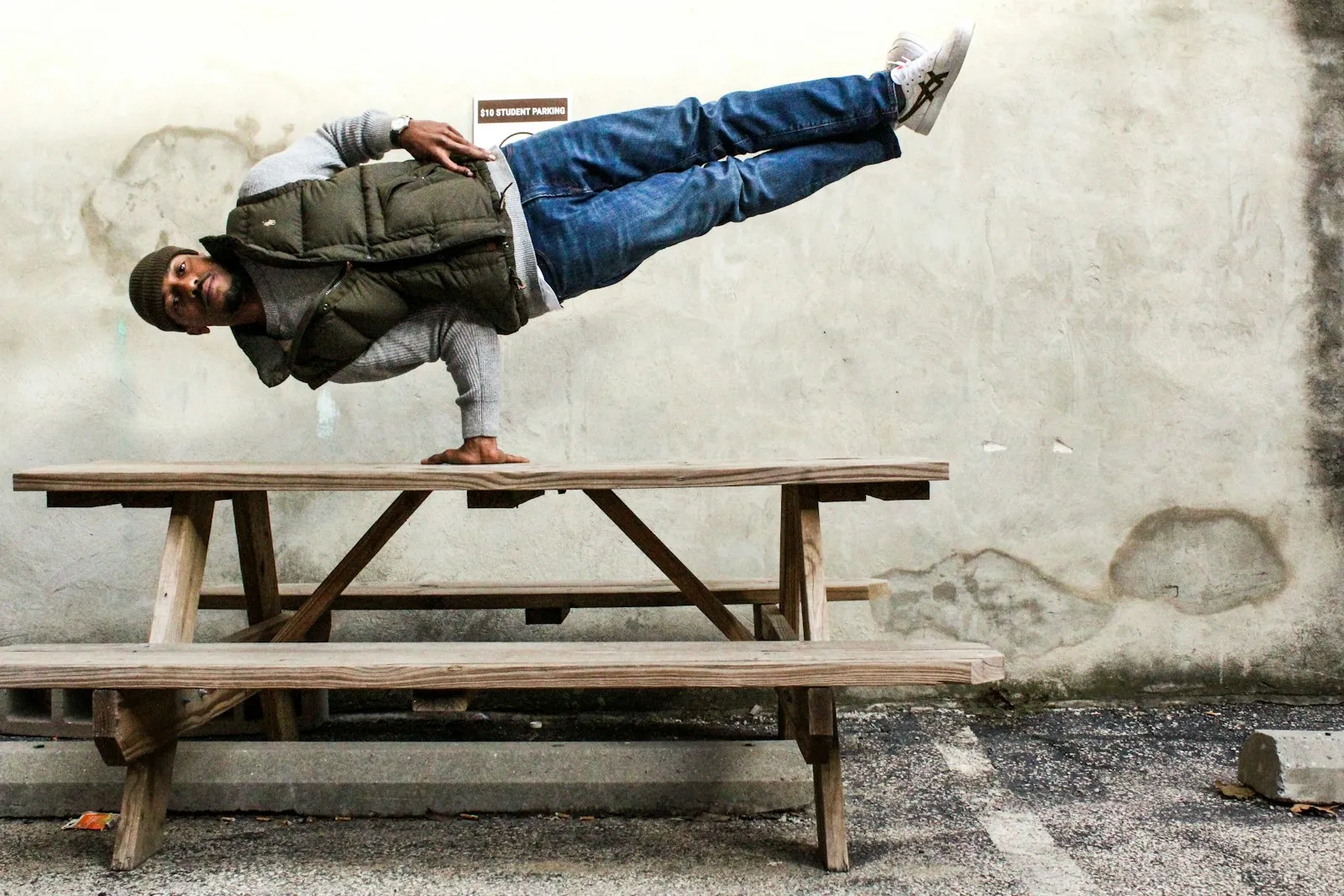
How to do a dragon flag safely: the setup, muscles worked, prerequisites, a step-by-step progression from tuck negatives to full reps and an 8-week plan.
The dragon flag is one of the hardest core exercises you can do with your bodyweight. You lie on a bench, hold on behind your head, lift your whole body up to your shoulders and lower it back down as one straight, rigid plank, with nothing but your upper back touching the bench. It is widely associated with Bruce Lee, and it has a reputation for being reserved for the very strong. In reality it is a learnable skill, as long as you build up to it in the right order.
The short answer: lie on a flat bench and grab its edge or a solid post behind your head. Roll your hips up until your body points straight at the ceiling, resting on your upper back and shoulders, never on your neck. Then lower your body slowly as one straight line, from shoulders to toes, without bending at the hips or arching your lower back, and come back up. Most people should start with tuck dragon flag negatives: 3 to 4 sets of 3 to 5 slow lowerings, two or three times a week, and only move to straight legs once they can control a five-second descent with the knees tucked. If your hips bend or your back arches, the version is too hard.
Below: what the exercise is, the muscles it works, a test to know if you are ready, the setup, a nine-step progression with clear criteria to move up, the common mistakes and an eight-week plan. If you want dragon flag work placed in a full week of training, Titan Mode builds your calisthenics plan around your level and your equipment, and shows each exercise as you go.
What is a dragon flag?
A dragon flag is a lever: your shoulders are the pivot, and your body, from shoulders to feet, is a long, straight bar that you raise and lower in a slow arc. The longer the bar and the closer it gets to horizontal, the harder your trunk has to work to stay straight. That is why the bottom of the movement, just above the bench, is the hardest part.
It is not a leg raise. In a leg raise, you bend at the hips and lift only the legs. In a dragon flag, the hips stay straight: your legs and your trunk move together, and only your upper back stays on the bench. The moment you bend at the hips to make it easier, you have turned it into a different, much easier exercise.
Muscles worked
The dragon flag is an anti-extension exercise: your muscles work hard to stop your body from sagging into an arch while gravity pulls on a long lever.
- Rectus abdominis: the main driver. It keeps your ribs pulled toward your pelvis and your lower back from arching.
- Obliques and transverse abdominis: they brace the trunk like a belt and stop it from twisting when one side tires first.
- Hip flexors and quadriceps: they keep the legs in line with the trunk.
- Glutes: they stop the hips from bending. A dragon flag with soft glutes almost always turns into a pike.
- Lats, triceps, shoulders and grip: they anchor you to the bench. Pull the bench toward you as if you were trying to bend it.
EMG research on abdominal exercises shows that long-lever and leg-lifting movements load the abdominal wall and hip flexors far more than a basic crunch (Escamilla et al., 2006). The dragon flag sits at the far end of that scale, which is why it needs preparation.
Are you ready? A quick test
Before trying straight-leg dragon flags, check these markers. They are practical guides, not official standards:
| Test | Target before full dragon flag work |
|---|---|
| Hollow body hold, full version | 45 to 60 seconds, lower back on the floor |
| Lying leg raises, slow | 3 × 10, lower back pinned |
| Hanging knee raises or leg raises | 10 strict reps without swinging |
| Reverse crunch to candlestick | 8 controlled reps |
If you miss two or more, start with the core work in our calisthenics abs workout for a few weeks. You can still practice the top of the dragon flag (step 2 below) in the meantime.
The setup: bench, floor or bar
- Flat bench: the classic option. Lie with your head near one end and grab the bench on each side of your head, or the uprights of a rack behind it.
- Floor: lie down and grab something heavy and stable behind your head: a post, a sturdy piece of furniture that cannot move, a low bar in a park. Check that it cannot tip over before you put your full weight on it.
- Decline bench: with your head at the high end, it shortens the range slightly at the bottom. Useful for early negatives.
Wherever you do it, the load must rest on your upper back and the back of your shoulders, not on your neck or head. If you feel pressure on your neck, move further down the bench or tuck your chin and turn slightly onto your shoulder blades.
How to do a dragon flag, step by step
- Lie on your back and grip the bench or anchor behind your head, elbows bent and pointing up.
- Pull hard on the anchor, as if you wanted to bring it toward your hips. This locks your upper body in place.
- Roll up: bring your knees to your chest and lift your hips until your body points at the ceiling, resting on your upper back.
- Lock the line: extend your legs straight up, squeeze your glutes and legs together, ribs down, pelvis slightly tucked. Your body should be one straight line from shoulders to toes.
- Lower slowly: let the whole body tilt down in one piece, aiming for four or five seconds. Keep your hips straight; do not let them bend or sag.
- Stop just above the bench, then raise the body back up in the same straight line, or bend the knees to return to the top if you are doing negatives.
- Breathe: short breaths while staying braced. Holding your breath for a whole set raises blood pressure and makes the end of the set shakier.
The rule that decides everything: the line comes before the range. A dragon flag that stops halfway down with a perfect body line is worth more than one that touches the bench with bent hips.
Dragon flag progression: from foundation to full reps
Start at the first level you cannot yet do cleanly for the target. Move up when you hit the “move on” target in two sessions in a row.
| Level | Exercise | How it looks | Move on when |
|---|---|---|---|
| 1 | Reverse crunch to candlestick | From lying, roll the hips up until the legs point at the ceiling, then lower slowly | 3 × 8 slow reps |
| 2 | Candlestick hold | Hold the top position, body straight, weight on the upper back | 3 × 20 s |
| 3 | Tuck dragon flag negative | From the top, knees bent at 90°, lower the hips and trunk in one piece | 3 × 5 lowerings of 5 s |
| 4 | Tuck dragon flag raise | Lower and raise with the knees tucked, no bending at the hips | 3 × 5 reps |
| 5 | Single-leg or straddle negative | One leg straight and one bent, or legs wide apart | 3 × 4 lowerings of 5 s |
| 6 | Full dragon flag negative | Straight legs together, lowered in 5 seconds | 3 × 4 lowerings |
| 7 | Partial-range dragon flag | Full body line, lowered to about 45°, then raised | 3 × 5 reps |
| 8 | Full dragon flag | Lowered to just above the bench and raised, body straight | 3 × 5 reps |
| 9 | Harder versions | Pause holds at the bottom, slower tempo, light ankle weights | Your choice |
Two ways to adjust the difficulty inside a level, so you rarely need to jump a whole step: change how far down you go, and change how long the lever is (knees more or less tucked, legs more or less apart). The “move on” targets follow the general resistance-training principle of increasing the difficulty once a given load becomes manageable for the planned reps (ACSM, 2009).
Common mistakes
- Bending at the hips: the most common one. The hips fold, the legs drop and it becomes a leg raise. Squeeze your glutes and shorten the lever instead.
- Arching the lower back: the belly pushes out and the back takes the load, often at the bottom of the descent. Go back to a tuck or stop higher.
- Weight on the neck: the head is pushed into the bench and the neck bends. Shift the load onto the shoulder blades and tuck the chin slightly.
- Dropping fast: a two-second fall teaches nothing. If you cannot lower in four or five seconds, the level is too hard.
- Loose grip and arms: if the upper body slides, the whole lever collapses. Pull on the anchor the whole time.
- Training to failure every time: the last reps of a failing set are the ugly ones. Stop one rep early and keep the quality.
An 8-week dragon flag plan
Two or three sessions a week, with at least one rest day between them, at the start of the session while you are fresh. Rest two minutes between sets. Pick the progression level that fits you; these weeks assume you start at level 3 (tuck negatives).
| Week | Main work | Support work |
|---|---|---|
| 1 | Tuck negatives: 3 × 3 (5 s) | Candlestick hold 3 × 15 s |
| 2 | Tuck negatives: 4 × 3 (5 s) | Hollow body hold 3 × 30 s |
| 3 | Tuck negatives: 3 × 5 (5 s) | Hanging knee raises 3 × 8 |
| 4 | Easier week: tuck raises 3 × 3 | Hollow body hold 2 × 30 s |
| 5 | Tuck raises 3 × 5 | Single-leg negatives 2 × 3 |
| 6 | Single-leg or straddle negatives 3 × 4 (5 s) | Hanging leg raises 3 × 6 |
| 7 | Full negatives 3 × 3 (5 s) | Candlestick hold 3 × 20 s |
| 8 | Test: one set of full negatives, then partial-range reps 3 × 3 | Easy core work |
If a session goes badly, repeat the week instead of moving on. Logging what you actually did, not what was planned, is what tells you when you’re ready for the next level; Titan Mode logs every set and lets you swap an exercise for an easier or harder version when the plan doesn’t fit the day.
Where the dragon flag fits in your training
The dragon flag is a strength exercise, so treat it like one: low reps, long rests, early in the session. It pairs well with skill work that needs the same rigid body line:
- Front lever: both exercises hold a straight body against gravity. The dragon flag trains the trunk part with the shoulders supported, which makes it a useful support exercise for the front lever progression.
- L-sit: the hip flexor and abdominal strength carry over directly. See the L-sit progression.
- Human flag: a different plane (sideways), but the same idea of a body held straight by the trunk. Our human flag guide covers that one.
- Handstand and planche: a stronger hollow shape means a straighter line upside down and a more stable lean forward.
For most people, one or two dragon flag sessions a week inside a normal full-body plan, such as a 12-week beginner program once the basics are in place, is enough.
Dragon flag vs other core exercises
- Hollow body hold: the floor version of the same body shape. Easier, safer to learn and the best preparation.
- Hanging leg raise: trains the hip flexors and lower abs through hip flexion. Easier to scale, but it bends at the hips, which a dragon flag does not.
- Ab wheel rollout: another long-lever anti-extension exercise. Close in spirit; standing rollouts are about as hard as a full dragon flag for many people.
- Plank: the entry level of the same job, resisting a sag. Useful for beginners, too easy on its own once you are strong.
Safety and limits
- Lower back pain: effort in the abs is normal; pain in the lower back is a sign the version is too hard. Regress to a tuck and stop higher. Ongoing back pain, or pain that spreads into a leg, should be assessed by a professional before you load your core this hard.
- Neck: never let your body weight rest on your neck. If you cannot avoid it, stay on the candlestick and tuck variations until your setup is right.
- Blood pressure, pregnancy, hernia, recent abdominal surgery: exercises with this much effort and bracing are not the place to start. Get medical advice first.
- Equipment: check that the bench, post or furniture cannot move. A sliding bench in the middle of a lowering is a real fall risk.
Core training guidance favours exercises that hold the spine still against a load, with a gradual increase in difficulty (McGill, 2010; Behm et al., 2010). The dragon flag fits that description at the top end, which is exactly why it should be earned rather than forced.
A word on visible abs
The dragon flag will make your abdominal muscles very strong. It won’t, by itself, make them visible: a controlled trial found that six weeks of abdominal exercises alone did not reduce abdominal fat (Vispute et al., 2011). Visible abs depend mainly on your body fat, which is set by your diet and your overall activity.
Earn the lever
The dragon flag rewards patience: a few slow, clean negatives two or three times a week, a level at a time, and the full rep arrives. Start where your hips stay straight, write down your sets and move up only when the numbers say so. If you’d rather have that progression planned inside a full week of training, download Titan Mode and set up your calisthenics plan.
This article is general information, not medical advice. If you have a medical condition, an injury, pain or are pregnant, talk to a health professional before changing your training or diet.
FAQ
Is the dragon flag bad for your back?
Not when it is done at a level you can control. The risk comes from letting the lower back arch while the legs are low, which puts the load on the spine instead of the abs. Keep your body in a slightly rounded hollow shape, use an easier version (tucked knees, one leg, shorter range) until you can, and stop if you feel pain in your lower back rather than effort in your abs.
How long does it take to learn the dragon flag?
It depends on your starting point. Someone who already holds a 60-second hollow body hold and does strict hanging leg raises often reaches controlled full negatives in a few weeks and full reps in two to four months. Starting from little core training, plan on several months, beginning with the foundation exercises.
What muscles does the dragon flag work?
Mainly the abdominal wall: the rectus abdominis, obliques and transverse abdominis, which keep the trunk rigid. The hip flexors and quads keep the legs in line, the glutes keep the hips from bending, and the lats, triceps and shoulders hold the upper body anchored to the bench.
Can I do dragon flags on the floor without a bench?
Yes, if you have something solid to hold behind your head: a heavy piece of furniture that cannot move, a post, a door frame, a low bar in a park or a partner's ankles. Lie with your upper back on the floor, grip the anchor and do the same movement. Check that the anchor cannot tip over before you start.
Is the dragon flag harder than the front lever?
They are hard in different ways. The dragon flag keeps your shoulders supported on a bench, so it mostly tests the abs and the body line. The front lever hangs from the bar and asks a lot more of the lats and shoulders. Many people get a full dragon flag well before a full front lever, and the dragon flag is a useful support exercise on the way.
How many dragon flags should I do?
Quality first: 3 to 5 sets of 3 to 6 reps, or of 3 to 5 slow negatives, two or three times a week. Stop the set as soon as your hips bend or your lower back arches. More reps of bad form do not build the strength you need for clean ones.
Sources
- Escamilla R.F. et al. (2006). Electromyographic analysis of traditional and nontraditional abdominal exercises: implications for rehabilitation and training. Phys Ther.
- McGill S.M. (2010). Core training: evidence translating to better performance and injury prevention. Strength Cond J.
- American College of Sports Medicine (2009). Position stand: progression models in resistance training for healthy adults. Med Sci Sports Exerc.
- Behm D.G. et al. (2010). Canadian Society for Exercise Physiology position stand: the use of instability to train the core in athletic and nonathletic conditioning. Appl Physiol Nutr Metab.
- Vispute S.S. et al. (2011). The effect of abdominal exercise on abdominal fat. J Strength Cond Res.