Russian Twist: How to Do It, Muscles Worked, Is It Safe?
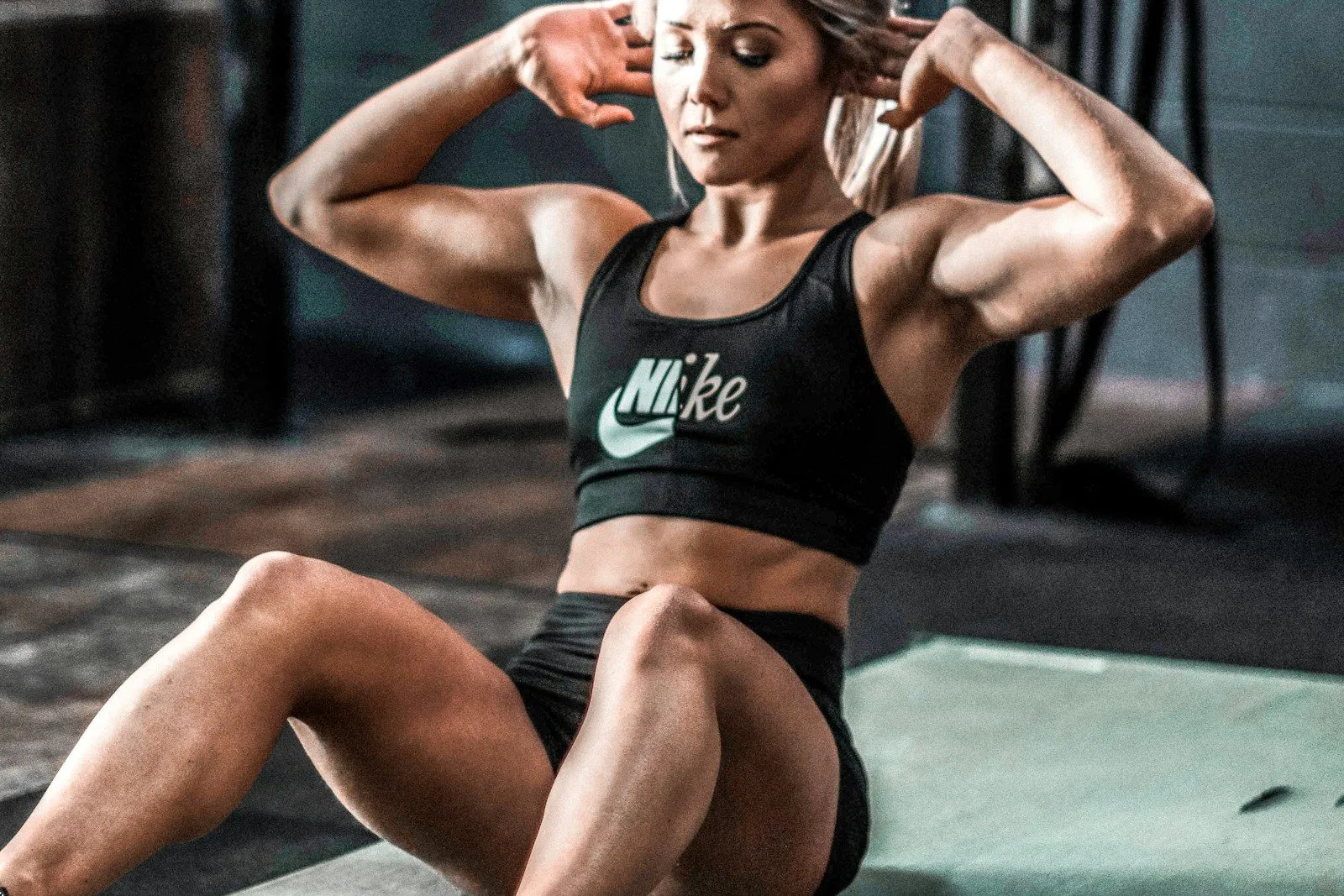
How to do a Russian twist with good form, the muscles it works, whether it's bad for your back, common mistakes, progressions and better oblique options.
The Russian twist is in almost every ab workout online, usually done the same way: feet up, back rounded, a medicine ball swinging from side to side as fast as possible. That version mostly trains momentum and puts your lower back in the position spine researchers worry about. Done slowly, with a long spine and the rotation coming from your ribcage, it’s a reasonable oblique exercise. The difference is all in the details.
In short: sit on the floor, knees bent, heels on the ground. Lean back to about 45° with a straight back and your chest up, arms in front of you, hands together. Brace your abs, then turn your shoulders and ribcage to one side, pause, come back through the middle and turn to the other side. Your hips and knees stay still and pointing forward. Start with 2 to 3 sets of 10 to 16 slow twists (each side counts as one), two or three times a week. Lift your feet or add a light weight only once you can keep your back straight for the whole set. If you have back pain or a disc problem, skip it and use side planks and Pallof presses instead.
Below: what the Russian twist really works, the honest answer to “is it bad for your back?”, step-by-step form, the mistakes that make it risky, a progression from easiest to hardest, better alternatives for the obliques, and how to fit it into a training week. If you want a core routine built around your level and schedule, Titan Mode creates a weekly calisthenics plan with guided sessions and exercise demos.
What is a Russian twist?
It’s a seated rotation exercise: you hold your torso at an angle, leaning back, and turn your shoulders from side to side. The goal is to train the muscles that rotate the trunk, mainly the obliques, while the rest of the core holds you in position.
It belongs to the “rotation” family of core exercises. Most of the time, though, your core’s job is the opposite: to stop your spine from twisting when you carry a bag on one side, throw, push or run. That’s why a good calisthenics abs workout mixes exercises that create rotation, like the Russian twist, with exercises that resist it, like the side plank.
Muscles worked
- External and internal obliques: the main movers. They turn your ribcage toward each side. In a classic study of trunk twisting, the external obliques and the latissimus dorsi were among the main muscles producing rotation (McGill, 1991).
- Rectus abdominis: it works mostly isometrically to stop you from falling back. The more you lean back, the harder it works.
- Hip flexors: they hold your legs and torso at an angle, especially with your feet off the floor. Feeling it in the front of your hips is common.
- Transverse abdominis and back extensors: they keep the spine stable and stop the lower back from rounding.
- Shoulders and arms: a small role, more if you hold a weight away from your body.
The same study made another useful point: during twisting efforts, the trunk muscles contract on both sides at once to stabilise the spine, and much of that activity doesn’t produce rotation at all. In other words, the core is built to control rotation as much as to create it.
Are Russian twists bad for your back?
This is the question most people actually search for, and the honest answer is: it depends on how you do them and on your back.
What the research shows. In laboratory studies on pig spines (a common model for human discs), repeated bending of the spine under moderate compression produced disc herniations, even without heavy loads (Callaghan and McGill, 2001). When twisting was added to repeated bending, damage inside the disc appeared in most specimens, while twisting alone did not start a herniation (Marshall and McGill, 2010). The typical gym version of the Russian twist combines exactly those ingredients: a rounded lower back, rotation, compression from leaning back, and a lot of fast repetitions.
What it doesn’t show. These were animal spines in a machine, bent thousands of times, not people doing a few sets a week. Human spines adapt to training, and there’s no study showing that Russian twists done with good form injure healthy people. Saying “the Russian twist will destroy your back” goes beyond the evidence.
What to do with it:
- If you’re healthy and pain-free, the controlled version described below, with a long spine and a moderate range, is a reasonable exercise.
- Avoid the fast, rounded, heavy version. It adds risk without adding much benefit.
- If you have a known disc problem, sciatica or back pain that gets worse when you bend forward, leave it out and train the obliques with anti-rotation exercises instead (see below). If in doubt, ask a physiotherapist.
How to do a Russian twist, step by step
- Sit down. On a mat, knees bent at about 90°, heels on the floor, feet hip-width apart.
- Lean back. Keep your back straight and lean back to about 45°, until you feel your abs switch on. Chest up, shoulders down, neck long.
- Set your arms. Arms in front of your chest, elbows slightly bent, hands together or holding a light object. Your hands stay in front of your sternum; they move because your torso turns.
- Brace. Breathe out and tighten your abs as if bracing for a light punch. Your lower back should stay neutral, not rounded into a “C”.
- Turn. Rotate your shoulders and ribcage to one side, as far as you can without your knees moving or your back rounding. Your eyes follow your hands.
- Pause. One second at the end of the turn.
- Come back and switch. Return through the middle with control and turn to the other side. That’s two reps.
Breathe out as you turn, in as you come back to the middle. One rep should take about two seconds; this is not a speed exercise.
Cues that help
- “Turn your chest, not your arms”: if your hands travel further than your shoulders, you’re swinging.
- “Knees stay pointing at the ceiling”: stops the hips from rocking.
- “Tall spine”: imagine someone pulling your head up toward the ceiling.
- “Smaller range, better reps”: you don’t need to touch the floor beside your hip.
Common mistakes and how to fix them
| Mistake | Why it’s a problem | Fix |
|---|---|---|
| Rounded lower back | Combines bending and twisting of the spine | Sit taller, lean back less, keep heels on the floor |
| Swinging the arms | Shoulders work, obliques don’t | Hands stay in front of the chest; turn the ribcage |
| Going too fast | Momentum does the work, less control | 2 seconds per rep, 1-second pause on each side |
| Knees and hips rocking | The rotation comes from the hips | Squeeze a cushion between your knees |
| Feet up too early | Back rounds to hold the position | Heels down until a full set is clean |
| Weight too heavy | Form breaks, the back takes the load | Start with no weight, then 2–5 kg at most |
| Holding your breath | Pressure, neck tension | Breathe out on each turn |
Russian twist progression
Choose the first level you can do for 2 sets of 12 controlled twists with a straight back. Move to the next level when you reach the target.
| Level | Version | How it works | Move on when |
|---|---|---|---|
| 1 | Supported twist | Leaning back against your hands or a wall, small rotations | 3 × 16 |
| 2 | Feet-down Russian twist | The standard version above, hands together | 3 × 16 |
| 3 | Paused twist | 2-second hold at each side | 3 × 12 |
| 4 | Long-lever twist | Arms extended straight in front of you | 3 × 12 |
| 5 | Feet-up twist | Heels lifted a few centimetres, shins parallel to the floor | 3 × 12 |
| 6 | Weighted twist | Light weight (water bottle, 2–5 kg) held at your chest, feet down first | 3 × 12 |
| 7 | Weighted, feet up | Combine levels 5 and 6, still slow | 3 × 10 |
Don’t rush to heavy weights. The obliques respond to hard, controlled sets, and a light weight held a bit further from your body is enough to make the exercise very demanding.
Better options for the obliques
If you want strong obliques, the Russian twist doesn’t have to be the main exercise. These options train the same muscles, several with less spinal twisting:
- Side plank and its progressions (top leg raised, hip dips, star plank). One of the best exercises for the obliques and the side of the hip. Our guide to the plank exercise covers the basics.
- Pallof press: a band anchored at chest height to one side, you press it straight out and hold without letting it pull you round. Pure anti-rotation.
- Hanging oblique knee raises: from a bar, bring your knees up toward one side. They pair well with the hanging leg raise.
- Windshield wipers: lying or hanging, legs swing side to side under control. Advanced when done hanging.
- Suitcase carry: walk holding a heavy bag in one hand without leaning. Simple and very effective.
- Hollow body hold: it doesn’t train rotation, but it builds the trunk stiffness that makes every rotation exercise safer; see our hollow body guide.
A balanced core routine uses one exercise from each family: anti-extension (plank, hollow body), anti-rotation (Pallof press, side plank), rotation (Russian twist, oblique knee raises) and hip flexion (leg raises).
How many sets and reps, and how often?
- Sets and reps: 2 to 3 sets of 10 to 20 controlled twists (each side counts as one), or 30 to 45 seconds of slow work. End each set when your form starts to slip, not when you can’t move.
- Rest: 45 to 60 seconds.
- Frequency: two or three times a week, at the end of a session. The ACSM recommends training each muscle group two to three times a week for most adults (ACSM, 2009), and core work is no exception.
A sample core routine with Russian twists
Two or three times a week, after your main workout:
| Exercise | Sets × reps or time | Rest |
|---|---|---|
| Plank or hollow body hold | 3 × 20–40 s | 45 s |
| Side plank | 2 × 20–30 s per side | 30 s |
| Russian twist (your level) | 3 × 12–16 | 45 s |
| Hanging knee raise or lying leg raise | 3 × 8–12 | 60 s |
Write down your times and reps every session, then move one exercise up a level whenever you hit the target. That’s the part most people skip, and why their core work stays the same for months. Titan Mode guides each session set by set, with a rest timer and the option to swap an exercise for an easier or harder version, and it tracks your progress with weekly check-ins.
Benefits and limits
- Stronger rotation. Useful for sports that involve throwing, hitting or turning: tennis, combat sports, football.
- Trunk endurance. Holding the leaned-back position for a whole set builds endurance in the abs and hip flexors.
- No equipment needed. A floor is enough, and a bottle of water makes a fine weight.
- It won’t flatten your stomach. In a six-week trial, adding abdominal exercises to a diet did not reduce belly fat compared with diet alone (Vispute et al., 2011). Fat loss comes from diet and overall activity; see our guide to calisthenics for weight loss.
- It’s not essential. Plenty of strong athletes never do Russian twists. If they bother your back, there are good alternatives.
Safety
- Back pain during or after: reduce the range, put your heels down and lean back less. If it persists, stop and use anti-rotation exercises.
- Known disc herniation, sciatica or recent back injury: avoid loaded spinal twisting unless a health professional has cleared it.
- Pregnancy and postpartum: seated twists and leaning-back positions can strain the abdominal wall; get advice from your midwife, doctor or a pelvic health physiotherapist.
- Osteoporosis: combined bending and twisting of the spine is generally discouraged; check with your doctor.
- Neck tension: keep your chin slightly tucked and your gaze following your hands.
Slow is the point
The Russian twist works when it’s slow: long spine, chest up, rotation from the ribcage, a pause at each side. The fast, rounded, heavy version is the one that gives it a bad reputation. Use it as one part of a balanced core routine, progress it with pauses and longer levers before adding weight, and replace it with side planks or Pallof presses if your back says no. If you want that routine planned and tracked inside a full week of calisthenics, download the app and set up your plan in a few minutes.
This article is general information, not medical advice. If you have a medical condition, an injury, pain or are pregnant, talk to a health professional before changing your training or diet.
FAQ
What muscles do Russian twists work?
Mainly the obliques, the muscles on the sides of your waist that rotate the trunk. The rectus abdominis (the 'six-pack') works hard to hold you in the leaned-back position, the hip flexors hold your legs and torso at an angle, and the deep abdominal and back muscles stabilise the spine. Your shoulders work a little when you hold a weight.
Are Russian twists bad for your back?
They're not dangerous for most healthy people when done slowly with a straight spine and a moderate range. The concern comes from the common version: a rounded lower back, a fast swing and a heavy weight, which combines bending and twisting of the spine under load. Lab studies on animal spines link repeated flexion, especially combined with twisting, to disc damage. If you have a disc problem or back pain, choose anti-rotation exercises like the Pallof press or side plank instead.
How many Russian twists should I do?
Two or three sets of 10 to 20 controlled twists (counting each side as one) is plenty. Slow, controlled reps with a pause at each side are harder and safer than fast ones. If you can do more than 20 per side easily, make them harder with a pause, a longer lever or a light weight rather than adding reps.
Do Russian twists burn belly fat or slim the waist?
No. You can't burn fat from one area by training the muscles underneath it. A controlled trial found that six weeks of abdominal exercises alone did not reduce belly fat. Fat loss comes from your overall diet and activity. Russian twists strengthen the obliques; they don't shrink the waist on their own.
Should my feet be on the floor or lifted?
Start with your heels on the floor. It lets you focus on rotating with a straight back. Lift your feet only once you can keep your spine long and your chest up for a full set. Lifting the feet makes the hip flexors and abs work harder to hold the position; it doesn't make the twist itself better.
Are Russian twists good for beginners?
The feet-down, bodyweight version is fine for beginners if it doesn't cause back pain. Most beginners will get more from building basic core strength first with the plank, side plank and dead bug, then adding controlled twists. The weighted, feet-up version is an intermediate exercise.
What can I do instead of Russian twists?
For the obliques with less spinal twisting: the side plank and its variations, the Pallof press with a band, bird dogs, hanging oblique knee raises and suitcase carries. Many coaches prefer these 'anti-rotation' exercises because they train the core to resist twisting, which is how it works most of the time in sport and daily life.
Sources
- McGill S.M. (1991). Electromyographic activity of the abdominal and low back musculature during the generation of isometric and dynamic axial trunk torque: implications for lumbar mechanics. J Orthop Res, 9(1), 91–103.
- Callaghan J.P. & McGill S.M. (2001). Intervertebral disc herniation: studies on a porcine model exposed to highly repetitive flexion/extension motion with compressive force. Clin Biomech, 16(1), 28–37.
- Marshall L.W. & McGill S.M. (2010). The role of axial torque in disc herniation. Clin Biomech, 25(1), 6–9.
- Vispute S.S. et al. (2011). The effect of abdominal exercise on abdominal fat. J Strength Cond Res.
- American College of Sports Medicine (2009). Progression models in resistance training for healthy adults. Med Sci Sports Exerc, 41(3), 687–708.