Hanging Leg Raise: Form, Muscles Worked, Progression
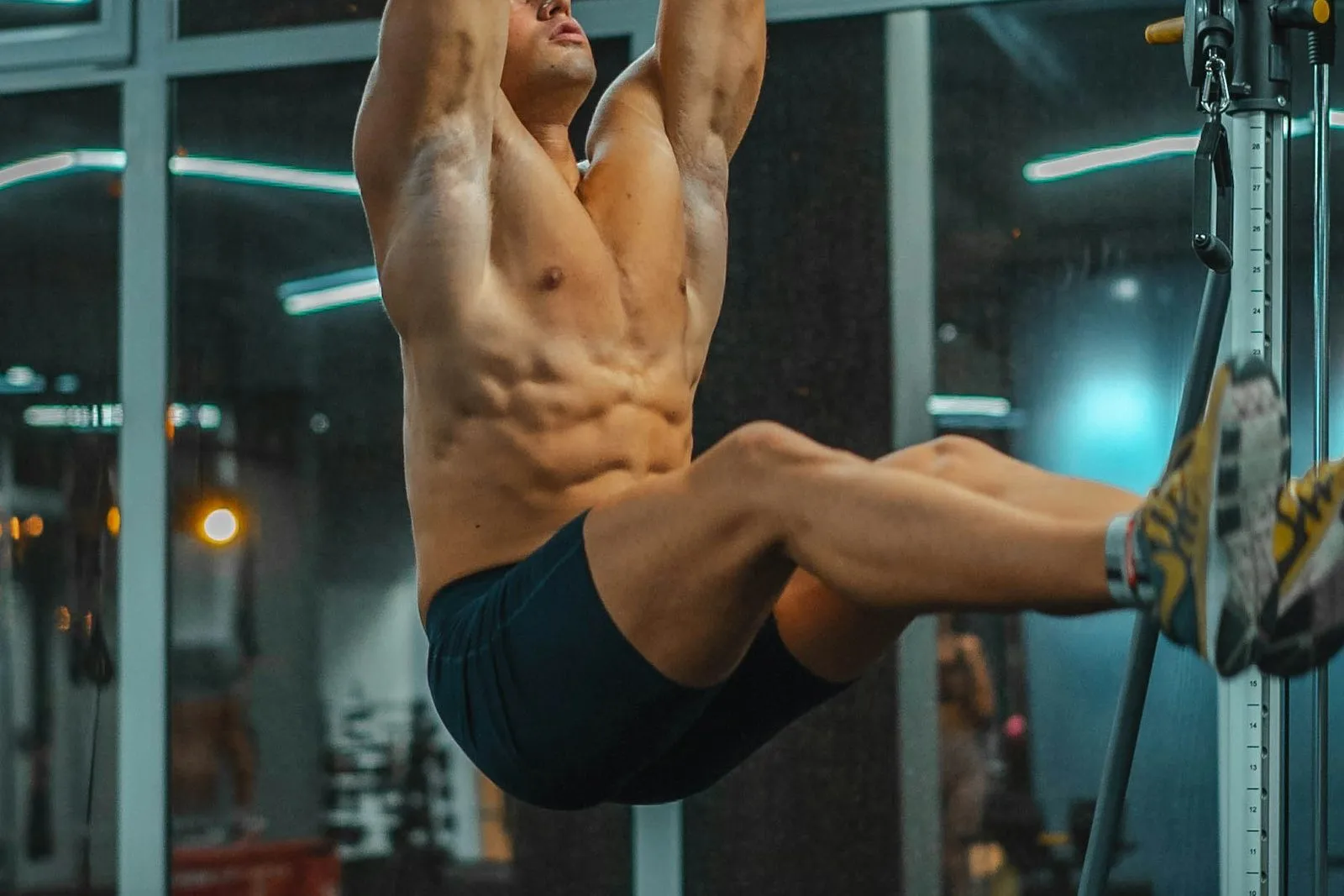
How to do a hanging leg raise without swinging: muscles worked, the knee raise to toes-to-bar progression, sets and reps by level, mistakes and alternatives.
The short answer: hang from a pull-up bar with straight arms and active shoulders, brace your abs, then lift your legs in front of you to at least hip height without swinging, curl your pelvis up slightly at the top and lower in two to three seconds. If you can’t do that yet, start with hanging knee raises, then move to one leg straight, straight legs to 90°, legs above 90° and finally toes-to-bar. Do 3 to 4 sets of 6 to 15 strict reps, two or three times a week, and move up a level once 3 sets of 10 to 12 feel clean.
The hanging leg raise is one of the most useful core exercises in calisthenics because it trains the abs, the hip flexors, the grip and the shoulders together, exactly the way bar skills like the L-sit, the muscle-up and the front lever use them. Below: the exact technique, what it really works, a level-by-level progression, how to program it, the mistakes that turn it into a swing, and what to do if you have no bar. If you would rather follow the progression inside a full week of training, Titan Mode builds your calisthenics plan around your level and your equipment, and logs every set so you know when to move up.
How to do a hanging leg raise, step by step
- Grip the bar with your hands shoulder-width apart, palms facing away. A full grip with the thumb around the bar is the most secure.
- Hang with active shoulders. Arms straight, but pull your shoulders slightly down away from your ears, as in an active dead hang. This stabilises the shoulder and cuts the swing.
- Set your body. Squeeze your legs together, point your toes lightly, tuck your ribs down and tense your abs as if someone were about to poke your stomach. Your body should be very slightly in front of the bar, not arched behind it.
- Lift the legs. Raise your legs in front of you, knees straight or slightly soft, until they are at least level with your hips. Breathe out on the way up.
- Curl at the top. When the legs reach horizontal, roll the pelvis up a little, as if you wanted to show the soles of your feet to someone in front of you. This is the part that really loads the abs.
- Lower slowly. Take two to three seconds to come down and stop with your feet slightly in front of you, not under or behind the bar. Pause for a second before the next rep so you start from stillness.
A good test: a partner watching from the side should see your legs go up and down while your torso stays almost still. If your whole body rocks back and forth, the reps are too fast or the variation is too hard.
Muscles worked
The hanging leg raise is often sold as a lower-abs exercise, but the picture is a bit more nuanced.
| Muscle | Role |
|---|---|
| Hip flexors (iliopsoas, rectus femoris) | Lift the legs; they do most of the work up to horizontal |
| Rectus abdominis | Holds the pelvis steady, then curls it up at the top |
| Obliques | Stabilise the trunk and resist swinging and twisting |
| Lats, lower traps, shoulders | Keep the shoulders engaged and the body under the bar |
| Forearms and grip | Hold you on the bar for the whole set |
In an electromyography study comparing abdominal exercises, Escamilla and colleagues found that hanging knee-ups (done with arm straps) were among the exercises that produced the highest activity in both the rectus abdominis and the obliques, more than the classic crunch, along with high hip-flexor activity. In practice this means the movement trains the abs hard as long as you control the pelvis instead of just swinging your legs up.
About “lower abs”: the rectus abdominis is one long muscle. You can bias the effort toward the area below the navel by curling the pelvis, but you cannot isolate it, and whether it shows depends mainly on your body fat, not on the exercise.
Prerequisites
You don’t need to be strong to start, but three things make the exercise much easier:
- Hang for 30 seconds or more. If your grip gives out after 15 seconds, it will end every set before your abs do. Our grip strength guide and the dead hang plan fix that in a few weeks.
- Hold a hollow body position on the floor. The hollow body hold teaches the same “ribs down, pelvis tucked” position you need on the bar. Aim for 20 to 30 seconds.
- Do 10 to 15 lying leg raises with control, lower back pressed into the floor.
The progression: from knee raise to toes-to-bar
Each level is harder because the legs are longer (a longer lever) or travel higher. Move up when you can do 3 sets of 10 to 12 strict reps with a slow descent and no swing.
Level 0: lying leg raises and the captain’s chair
On your back, hands under your hips or holding something behind your head, lift straight or bent legs to vertical and lower them slowly without letting your lower back arch. If you have access to a gym, the captain’s chair (the vertical station where you lean on your forearms) removes the grip from the equation and is a good stepping stone.
Level 1: hanging knee raise
Hang, then bring your knees up to hip height or higher, as if you were sitting on a chair in the air. Lower slowly. This is the version most people should start with. Once your knees reach your chest and you can curl the pelvis at the top, it already works the abs hard.
Level 2: single-leg extension
Raise both knees, then extend one leg in front of you at the top, alternating sides. Or raise with one leg straight and the other bent. It is a good bridge if straight legs drop you from 12 reps to 2.
Level 3: straight-leg raise to 90°
Legs straight and together, lift them until they are parallel to the floor, curl the pelvis slightly, lower slowly. If tight hamstrings force your knees to bend, keep a small bend: it is better than swinging.
Level 4: straight-leg raise above 90°
Keep lifting past horizontal until your feet reach roughly face height. Your hips have to roll up and your lats have to push the bar down a little. This is the version people usually mean by a full hanging leg raise.
Level 5: strict toes-to-bar
Lift until your feet touch the bar between your hands, then lower under control. It needs strong abs, flexible hamstrings and pressure through the lats. The kipping version used in CrossFit is a different, swing-based skill: fine for workouts, but it won’t build the same strength.
Further options
- Weighted raises: ankle weights or a light dumbbell held between the feet, for 6 to 10 reps.
- Windshield wipers and twisting knee raises for the obliques, once straight-leg raises are solid. On the floor, a slow Russian twist trains the same rotation.
- Hanging L-sit hold: hold the legs at 90° for 10 to 30 seconds, a direct bridge to the L-sit.
Sets, reps and where to put it in your week
| Level | Variation | Sets × reps | Rest |
|---|---|---|---|
| Beginner | Hanging knee raises | 3 × 6–12 | 60–90 s |
| Intermediate | Straight-leg raises to 90° | 3–4 × 6–12 | 90 s |
| Advanced | Raises above 90° or toes-to-bar | 3–4 × 5–10 | 90–120 s |
| Strength focus | Weighted raises | 3–4 × 6–8 | 2 min |
Two or three sessions a week is enough. The simplest option is to add the exercise to the end of a pull or full-body session, after your main strength work: your grip will already be tired, which is fine because the sets are short. If you want a full core block around it, our calisthenics abs workout pairs it with a plank variation, a side plank and an anti-rotation exercise.
To know when to move up, write down your reps every session and the variation you used. Progress shows up as more clean reps, a slower descent and less swing, long before you can see it in the mirror. Titan Mode records your reps set by set and schedules your core work inside your weekly plan, so you can see the trend instead of guessing.
A simple 6-week plan from knee raises to straight legs
- Weeks 1–2: knee raises, 3 × 6–10, plus 2 × 20–30 seconds of hollow body hold on the floor.
- Weeks 3–4: knee raises 2 × 10–12, then single-leg extensions 2 × 5 per leg.
- Weeks 5–6: straight-leg raises to 90° 3 × 5–8; finish with 1 set of knee raises to near-failure.
If you stall, stay at the same level and slow the descent to four seconds before adding reps.
Common mistakes
- Swinging. The most common fault. Each rep should start from a still hang. Stop the legs slightly in front of you on the way down and pause.
- Arching the lower back at the bottom. Keep the ribs down and the abs tense in the hang, otherwise the hip flexors pull on the lumbar spine.
- Only lifting the legs, never curling the pelvis. Raising to horizontal with a flat pelvis is mostly a hip-flexor exercise. The curl at the top is where the abs earn their keep.
- Passive, shrugged shoulders. Hanging with your ears between your arms makes the body unstable and loads the shoulder passively. Pull the shoulders slightly down.
- Dropping the legs. The way down is half the exercise. Lower in two to three seconds.
- Jumping levels too soon. Five ugly straight-leg reps are worth less than twelve strict knee raises.
No bar? Alternatives that work
- Lying leg raises and reverse crunches on the floor, with the same pelvic curl at the top.
- Captain’s chair knee and leg raises at the gym.
- L-sit or tuck holds between two chairs or on parallettes, which train the same hip-flexion strength with the arms pushing instead of hanging.
- Doorway pull-up bar: a fixed bar that can take your weight is enough for hanging raises. Check the maximum load and how it fixes to the frame before you hang from it.
Safety and limits
- Warm up first: a few minutes of easy movement, arm circles, a couple of dead hangs and some lying leg raises.
- Shoulders: if you feel pain in the front or top of the shoulder while hanging, slightly bend the elbows, check that your shoulders are engaged, or train on a captain’s chair for a while.
- Lower back: stop the set when you can no longer keep the ribs down and the back starts to arch hard. If you have a back condition, check with a physiotherapist.
- Grip: chalk or straps help if the grip gives out much earlier than your abs.
- Hernia, pregnancy or recent abdominal surgery: ask your doctor before doing intense abdominal work.
- Core work is one part of training. Health guidelines such as the WHO’s recommend strength training for all major muscle groups at least twice a week, alongside regular aerobic activity.
The short version
Start with hanging knee raises, lift slowly from a still hang, curl the pelvis at the top and lower in two to three seconds. Move up a level once 3 sets of 10 to 12 strict reps feel easy: single-leg extension, straight legs to 90°, above 90°, then toes-to-bar. Two or three short sessions a week at the end of your training are enough, and the strength carries straight over to the L-sit, the dragon flag and the rest of your bar work.
This article is general information, not medical advice. If you have a medical condition, an injury, pain or are pregnant, talk to a health professional before changing your training or diet.
FAQ
What muscles do hanging leg raises work?
The hip flexors (iliopsoas and rectus femoris) lift the legs, and the abs, mainly the rectus abdominis and the obliques, hold the pelvis and curl it up at the top. The lats, shoulders and forearms keep you on the bar and stop the swing. The higher you lift and the more you curl the pelvis, the more the abs work.
Are hanging leg raises good for lower abs?
There is no separate lower-abs muscle: the rectus abdominis is one long muscle that contracts as a whole. Hanging leg raises are still one of the best exercises for the area below the navel, because the top of the movement asks the abs to roll the pelvis up toward the ribs. Whether those abs are visible depends mostly on body fat.
How many hanging leg raises should I do?
Most people do best with 3 to 4 sets of 6 to 15 slow, strict reps, two or three times a week. Move to the next variation once you hit 3 sets of 10 to 12 clean reps without swinging. Doing hundreds of fast reps mostly trains swinging and grip, not your abs.
Why can't I do hanging leg raises?
The usual reasons are a grip that gives out first, a body that swings, tight hamstrings that stop the legs below horizontal, or abs that are not yet strong enough. Start with hanging knee raises, use straps or a captain's chair if grip is the limit, and work on lying leg raises and the hollow body hold on the floor.
Do hanging leg raises hurt your back?
They are not dangerous for most healthy people, but they can bother the lower back if you let it arch hard at the bottom and swing. Keep the ribs down, start with bent knees, lower slowly and stop each rep before the legs swing behind you. If you have a back injury, ask a physiotherapist which version suits you.
What is the difference between a hanging leg raise and toes-to-bar?
A hanging leg raise usually stops with the legs at or a little above horizontal. Toes-to-bar keeps going until the feet touch the bar, which needs much more pelvic curl, hamstring flexibility and lat pressure. Strict toes-to-bar is the advanced end of the same progression; kipping toes-to-bar, common in CrossFit, uses a swing to get there.
Sources
- Escamilla R.F. et al. (2006). Electromyographic analysis of traditional and nontraditional abdominal exercises: implications for rehabilitation and training. Physical Therapy.
- McGill S.M. (2010). Core training: evidence translating to better performance and injury prevention. Strength and Conditioning Journal.
- World Health Organization (2020). WHO guidelines on physical activity and sedentary behaviour.