Grip Strength Exercises: How to Improve Your Grip
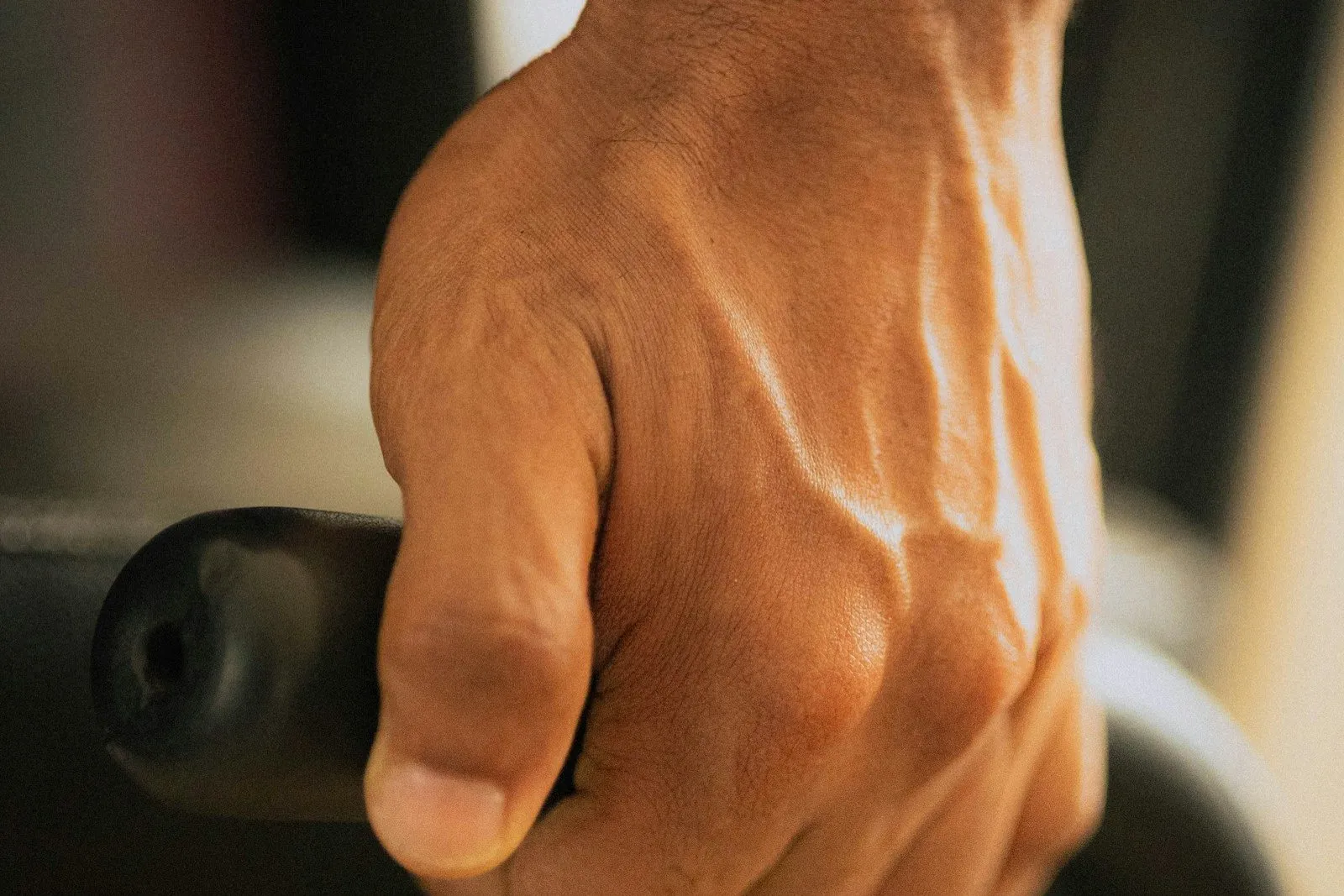
How to improve grip strength with or without equipment: the three types of grip, the best bar, home and forearm exercises, a 6-week plan and how to test it.
To improve grip strength, train your hands the way you train any other muscle: hold, squeeze and carry against a load that gets a little harder every week. The most effective exercises are bar hangs (dead hangs, towel hangs, one-arm hang progressions) and loaded carries; at home without a bar, towel wrings, fingertip holds, bag carries and backpack wrist curls do the job. Two or three short sessions a week are enough, and most people see their hang time go up within a few weeks.
This guide covers the three types of grip, why grip matters, how to test yours, the best exercises with a bar, at home and with simple tools, a six-week plan, and how to avoid sore elbows. If you’d rather have grip work built into your pulling days automatically, Titan Mode puts it in a weekly plan matched to your level and equipment, and logs every hang and set.
The three types of grip
Grip isn’t a single quality. Training one type improves the others a little, but not fully.
| Type | What it is | Everyday example | Best exercises |
|---|---|---|---|
| Support grip | Holding on for a long time | Hanging from a bar, carrying shopping bags | Dead hangs, farmer’s carries |
| Crush grip | Closing the hand hard | Handshake, opening a tight jar | Towel wrings, hand grippers, towel pull-ups |
| Pinch grip | Thumb against fingers | Carrying a board or a plate by its edge | Book or plate pinches |
Two more pieces complete strong hands: wrist strength (flexors and extensors of the forearm, which keep the wrist stable) and finger extensors, the small muscles that open the hand. They are often neglected, and balancing them helps keep elbows happy.
For calisthenics, support grip matters most: every pull-up, row, hang, muscle-up and lever starts with your hands holding the bar.
Why grip strength matters
- Pull-ups and skills. If your hands give out before your back does, your grip limits your training. That’s common with beginners, heavier people and anyone starting weighted pull-ups.
- Everyday life. Carrying, opening, holding a child or a suitcase all depend on it.
- A marker of overall strength. In the PURE study (Leong et al., 2015), which followed around 140,000 adults in 17 countries, each 5 kg lower grip strength was associated with a 16% higher risk of death from any cause. Reviews such as Bohannon (2019) describe grip as a simple, useful marker of health in older adults.
Be careful with that last point: it’s an association. A strong grip reflects being strong and active overall; squeezing a gripper won’t by itself change your health risks. What the research does support is that training improves grip: a meta-analysis of studies in older adults (Labott et al., 2019) found that exercise programs increased handgrip strength, with the clearest gains from programs that included strength training.
Grip also changes with age: data pooled from twelve British studies (Dodds et al., 2014) show it rises through early adulthood, stays fairly stable until middle age and then declines, which is one more reason to keep training it.
How to test your grip
- Dynamometer: the reference test, used by doctors and physiotherapists. Some gyms have one. Compare yourself with yourself over time rather than with charts.
- Max dead hang: the most practical test for calisthenics. Hang from a bar with both hands, arms straight, and time it until you let go. Around 30 seconds is a fair beginner goal and 60 seconds a solid level; our dead hang guide gives targets by level.
- Farmer’s carry: carry two equal loads (dumbbells, kettlebells, water containers) and note how far or how long you can go before putting them down.
Retest every three or four weeks, under the same conditions.
The best grip exercises with a pull-up bar
- Dead hang. Hang with straight arms, thumbs wrapped around the bar. Sets of 20 to 60 seconds. The foundation of everything else.
- Active hang and scapular pulls. Pull the shoulders down without bending the arms. Grip plus shoulder control, and the start of every pull-up.
- Towel hang. Drape one or two towels over the bar and hang from them. Much harder: it trains crush grip as well as support. Start with one hand on the bar and one on a towel.
- Mixed and narrow hangs. Vary the grip: overhand, underhand, close, wide. Each one shifts the load across the fingers.
- Flexed-arm hang. Hold the top of a chin-up for time. Grip and biceps together.
- One-arm hang progression. Hang with one hand while the other holds a band or a towel for light support, then let go briefly. Advanced: build up slowly, as it loads the elbow and shoulder heavily.
- Thick-bar hang. Wrap a towel around the bar to make it thicker, or use dedicated thick grips. A bigger bar is harder to hold.
- Pull-ups and rows themselves. Every inverted row and pull-up trains grip, especially without straps and with slow lowering.
Grip and forearm exercises without equipment
No bar? You can still train your hands well:
- Towel wring. Roll up a towel and twist it as hard as you can in both directions, 5 to 10 seconds per effort. Excellent for crush grip and forearms.
- Fingertip wall hold. Lean against a wall on your fingertips, arms straight, and hold. Move your feet back over the weeks to add load. A safer step before fingertip push-ups on the floor.
- Bag or water-container carries. Fill two shopping bags or containers and walk 30 to 60 seconds. This is a home farmer’s carry. Add weight over the weeks.
- Backpack wrist curls. Sit with your forearm on your thigh, hold a loaded backpack by the handle, palm up, and curl only the wrist. Then palm down for reverse curls (extensors).
- Book pinch. Pinch one or two heavy books between thumb and fingers, arm by your side, and hold.
- Finger extensions with a rubber band. Place a band around your fingers and open the hand against it, 15 to 25 reps. Balances all the squeezing.
- Door-frame or table-edge holds. Hold the frame of a sturdy door or the edge of a solid table and lean back slightly. Only on furniture you’re sure of.
Simple grip tools worth buying
You don’t need any of them, but some are cheap and useful:
- Chalk: lets your grip, not sweat, set the limit.
- Thick grips (rubber sleeves for a bar): make every hang and row harder.
- Hand gripper: good for crush grip, portable; start with an easy model.
- Kettlebell or dumbbells: the easiest way to load carries and wrist curls.
Our calisthenics equipment guide covers which pull-up bar to choose if you don’t have one yet.
A six-week grip plan
Do this two or three times a week at the end of a session or on its own (10 to 15 minutes), with a day between sessions. Stop each set one or two seconds before you would lose the bar.
| Weeks | With a bar | Without a bar |
|---|---|---|
| 1–2 | Dead hang 3 × 20–30 s; farmer’s carry 3 × 30 s; finger extensions 2 × 20 | Towel wring 3 × 5 efforts each way; bag carry 3 × 30 s; finger extensions 2 × 20 |
| 3–4 | Dead hang 3 × 30–45 s; towel hang (one towel) 3 × 10–15 s; carry 3 × 40 s; reverse wrist curl 2 × 15 | Fingertip wall hold 3 × 20 s; bag carry 3 × 45 s heavier; backpack wrist curls 2 × 15 each way |
| 5–6 | Dead hang 2 × 45–60 s; two-towel hang 3 × 10–20 s; flexed-arm hang 3 × 10–20 s; carry 3 × 45 s heavier | Fingertip hold 3 × 30 s, feet further back; book pinch 3 × 20 s; bag carry 3 × 60 s; wrist curls 2 × 20 each way |
Retest your max hang or your carry at the end of week 6. Keep pulling exercises in your week as well: pull-ups, rows and arm work give your forearms plenty of extra volume. The easiest way to see progress is to write every hang time down; Titan Mode logs each set and shows your numbers week after week, so you know exactly when to move to the next step.
Common mistakes
- Training grip to failure every day. The tendons of the fingers and elbow adapt more slowly than muscle. Hard sessions two or three times a week are plenty.
- Thumb-less grip on the bar. Wrap the thumb unless you have a specific reason not to; it’s safer and stronger.
- Using straps on everything. Fine for heavy rows if the goal is your back, but they stop your grip from catching up.
- Only squeezing, never opening. Add finger extensions and reverse wrist curls to balance the forearm.
- Jumping to one-arm hangs and towel pull-ups too early. Build a solid 45–60 second two-hand hang first.
Safety and limits
- Elbow pain: pain on the inside or outside of the elbow (often called golfer’s and tennis elbow) is a sign to reduce volume. Lower the load and the frequency, and see a physiotherapist if it lasts more than a couple of weeks.
- Fingers and wrist: sharp pain, numbness or tingling means stop. Mild forearm burn is normal; joint pain is not.
- Injuries and conditions: after a hand, wrist or elbow injury, or with arthritis or carpal tunnel syndrome, ask a doctor or physiotherapist which exercises suit you.
- Check your bar and furniture before hanging or leaning on them.
- Blood pressure: long, hard squeezes while holding your breath raise blood pressure. Keep breathing, and check with your doctor if you have high blood pressure or heart disease.
The short version
Hang, carry and squeeze two or three times a week, add a few seconds or a little weight each time, and balance it with finger extensions. Within a few weeks your grip should stop being the reason your sets end, and the pull-up bar becomes a place to get stronger instead of a place where your hands give up. A strong grip also pays off on skills: in the human flag, the top hand holds much of your body weight sideways on a vertical pole.
This article is general information, not medical advice. If you have a medical condition, an injury, pain or are pregnant, talk to a health professional before changing your training or diet.
FAQ
How can I increase my grip strength fast?
Hang from a bar and carry heavy things, two or three times a week, and add a little time or weight each session. Most people notice their hang time and carrying capacity improve within a few weeks, mostly because the nervous system learns to use the muscles better. Bigger, lasting gains in forearm strength take a few months.
Can you improve grip strength without equipment?
Yes. Towel wrings, fingertip wall holds, carries with full shopping bags or water containers, backpack wrist curls and finger extensions with a rubber band all train the hands and forearms. A pull-up bar makes it much easier, because hanging is the most effective grip exercise you can do with bodyweight.
Are hand grippers worth it?
They are cheap and good for crushing strength, and you can use them anywhere. But they only train one type of grip in a short range. For pull-ups and everyday carrying, hangs and carries transfer better. A gripper is a nice extra, not the core of your grip training.
How often should I train grip?
Two or three dedicated grip sessions a week of 10 to 15 minutes are enough for most people, with at least a day between hard sessions. Your pulling workouts already train grip, so count them in your total and back off if your fingers or elbows feel sore.
Why is grip strength linked to health?
Large studies have found that people with weaker grip tend to have a higher risk of death and disability, so doctors use grip as a quick marker of overall strength. It is an association: training your grip alone won't make you live longer, but the general strength training that improves grip is good for your health.
My grip fails before my back on pull-ups. What should I do?
Add hangs and holds at the end of your pull sessions, use chalk if your hands sweat, and make sure you wrap your thumb around the bar. Straps can help on heavy rows but avoid them on pull-ups if you want your grip to catch up.
Sources
- Leong D.P. et al. (2015). Prognostic value of grip strength: findings from the Prospective Urban Rural Epidemiology (PURE) study. The Lancet.
- Bohannon R.W. (2019). Grip strength: an indispensable biomarker for older adults. Clin Interv Aging.
- Dodds R.M. et al. (2014). Grip strength across the life course: normative data from twelve British studies. PLoS One.
- Labott B.K. et al. (2019). Effects of exercise training on handgrip strength in older adults: a meta-analytical review. Gerontology.