Bulgarian Split Squat: Form, Muscles Worked, Progression
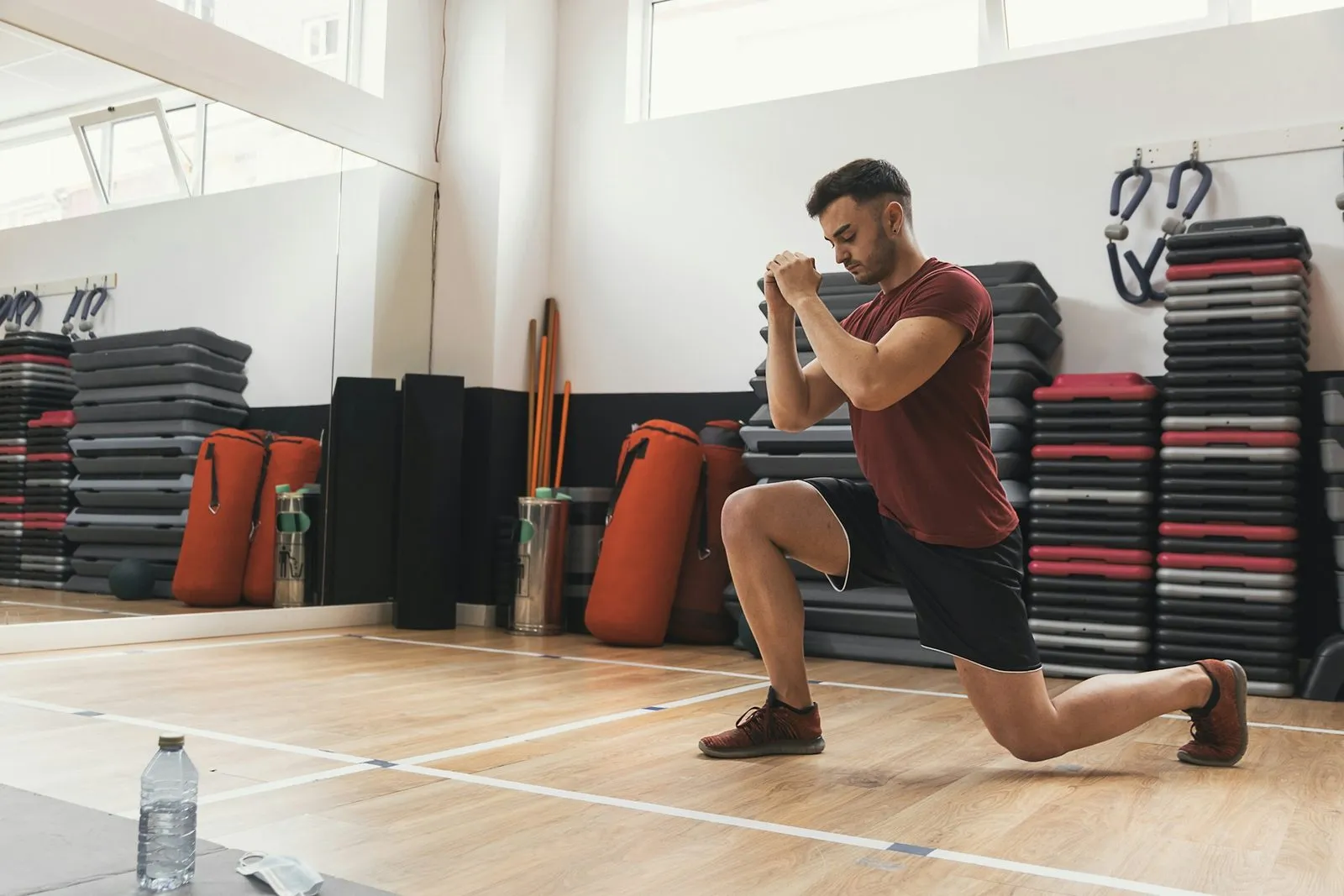
How to do a Bulgarian split squat: foot position, muscles worked, quad vs glute focus, common mistakes, a bodyweight progression and a 6-week plan.
The Bulgarian split squat has a reputation: everyone who does it properly ends up hating it a little. That’s a good sign. With your back foot on a bench, almost all your weight goes through one leg, through a long range of motion, which makes it one of the few leg exercises that stays genuinely hard without a barbell. For anyone training at home or in a park, it’s the backbone of leg day.
In short: stand about two feet in front of a bench, a chair or a step, facing away from it, and rest the top of your back foot on it. Keep most of your weight on the front foot. Lower straight down until your back knee almost touches the floor and your front thigh is about parallel to it, then push through the whole front foot to stand back up. Keep your front knee in line with your toes and your hips square. Start with 3 sets of 8 to 12 reps per leg, twice a week. If that’s too hard, begin with the floor split squat; once you pass 20 clean reps, slow down the tempo, add a pause or wear a loaded backpack.
Below: the exact setup (where the feet go, how high the bench should be), the muscles worked, how to bias the quads or the glutes, the mistakes that make it feel awful for the wrong reasons, an eight-step progression, and a six-week plan. If you’d rather have this exercise placed inside a complete week of training, Titan Mode builds a calisthenics plan around your level, schedule and equipment, with guided sessions and exercise demos.
What is a Bulgarian split squat?
It’s a split squat with the back foot raised, which is why it is also called the rear-foot-elevated split squat (RFESS). The front leg does most of the work: it bends at the knee and hip, then straightens to lift you. The back leg mostly helps you balance.
Compared with a regular squat, three things change:
- Load per leg. In a two-leg squat, each leg handles roughly half your bodyweight. In a Bulgarian split squat, the front leg carries most of it. For most people that’s a heavy exercise, with no weights at all.
- Range of motion. Raising the back foot lets you sink lower, so the front hip and knee bend further.
- Balance and control. The narrow base forces the side of the hip and the trunk to work to keep you steady.
That is why our calisthenics leg workout calls it the single best bodyweight leg exercise for many people, and why it’s the natural bridge between the basic squat and the pistol squat.
Muscles worked
- Quadriceps (front leg): they straighten the knee. They work hardest in the bottom half, especially with an upright torso.
- Gluteus maximus (front leg): it extends the hip as you stand up. It works more when the stance is longer and the torso leans slightly forward.
- Adductors (front leg): the inner thigh muscles also help extend the hip from a deep position.
- Gluteus medius and minimus: on the side of the hip, they keep the pelvis level and stop the knee from caving in.
- Hamstrings and calves: stabilisers, with a small role in the lift.
- Back leg: you’ll feel a strong stretch in the hip flexors and the front of the thigh. That’s normal.
- Trunk: abs and back muscles keep your torso from tipping or twisting.
What does the research say? In a biomechanics study of 20 trained men, both the Bulgarian split squat and the back squat were hip-dominant, and the split squat demanded less from the knee than the back squat did (Mackey and Riemann, 2021). The authors suggested the exercise suits programmes that want strong hip extension with lower knee demands. In a review of glute activation across many exercises, single-leg exercises such as step-ups and split squat variations ranked among those that work the gluteus maximus well (Neto et al., 2020). Keep in mind that muscle activity in a lab is not the same as muscle growth; what builds muscle is hard sets over weeks.
How to do a Bulgarian split squat, step by step
- Choose your support. A bench, a sturdy chair, a sofa or a park step. Knee height or a little lower is ideal: roughly 40 to 50 cm for most adults. Too high and your back hip gets pulled and your balance suffers.
- Place your back foot. Stand facing away from the support and rest the top of your foot (laces down) on it. If that’s uncomfortable, put the ball of your foot on it, toes tucked.
- Place your front foot. Hop it forward so that, at the bottom, your back knee lands just behind your front heel. A quick way to find it: sit on the edge of the bench, extend one leg, and put your front foot about where your heel lands. Feet are hip-width apart side to side, not on a tightrope.
- Brace. Stand tall, hips square to the front, ribs down. Hands on your hips, clasped in front of your chest, or holding a wall for balance.
- Lower. Bend both knees and drop straight down, as if you were sliding down a wall, in two to three seconds. Your front knee travels forward in line with your toes; your back knee heads toward the floor.
- Find the bottom. Stop when your back knee is a few centimetres from the floor or your front thigh is about parallel to it, whichever comes first without pain.
- Drive up. Push through the whole front foot (heel and big toe) to stand up. Don’t push off the back foot: it stays light.
- Repeat, then switch legs. Do all reps on one side, then the other. Start each set with your weaker leg.
Breathe in on the way down, out on the way up. If you wobble, slow down rather than speeding up.
Cues that help
- “Elevator, not escalator”: go straight down, not forward.
- “Back leg is a kickstand”: it balances, the front leg works.
- “Knee over the middle toes”: prevents the knee from caving in.
- “Whole foot on the floor”: keep the front heel down all the way.
Quads or glutes: how to change the focus
The same exercise can lean toward the front of the thigh or the glutes, depending on two settings.
| Setting | More quads | More glutes |
|---|---|---|
| Front foot distance | Slightly shorter stance | Slightly longer stance |
| Torso | Upright | Leaning forward a little (about 20–30°), back flat |
| Front knee | Travels forward past the toes | Stays closer to above the ankle |
| What you feel | Front of the thigh, above the knee | Glute and upper hamstring of the front leg |
Neither is “correct”. For balanced legs, a neutral stance with a slight forward lean works well. If your knees are sensitive, the longer, more hip-dominant version is usually more comfortable. Coaches often recommend these settings based on joint angles; the effect is logical (more hip bend means more glute work) but it hasn’t been measured precisely for every stance, so judge by what you feel and by your progress.
Common mistakes and how to fix them
| Mistake | What you feel | Fix |
|---|---|---|
| Front foot too close | Heel lifts, knee pain, cramped | Step the front foot forward a few centimetres |
| Front foot too far | Back hip overstretched, you can’t get low | Bring the front foot back; lower the bench |
| Feet in a straight line | Wobbling, tipping sideways | Keep the feet hip-width apart side to side |
| Bench too high | Back hip and lower back strained | Use a support at knee height or lower |
| Pushing off the back foot | Back thigh burning, front leg does little | Keep the back foot relaxed; lift your back toes slightly to test |
| Knee caving in | Inner knee discomfort | Push the knee out over the middle toes; slow the tempo |
| Bouncing at the bottom | Not much, then knee discomfort | Control the descent; pause one second at the bottom |
| Short, fast reps | Easy, little effect | Full range, two to three seconds down |
Bulgarian split squat progression (bodyweight)
Pick the first level you can do for 3 sets of 8 reps per leg with good form. Move up when you reach the target in the right-hand column.
| Level | Version | How it works | Move on when |
|---|---|---|---|
| 1 | Assisted split squat | Both feet on the floor, holding a wall or pole | 3 × 12 per leg |
| 2 | Split squat | Both feet on the floor, no support | 3 × 15 per leg |
| 3 | Assisted Bulgarian split squat | Back foot raised, one hand on a wall | 3 × 10 per leg |
| 4 | Bulgarian split squat | The standard version above | 3 × 15 per leg |
| 5 | Tempo Bulgarian split squat | 4 seconds down, 1-second pause at the bottom | 3 × 10 per leg |
| 6 | Deficit Bulgarian split squat | Front foot on a low step for extra range | 3 × 10–12 per leg |
| 7 | Loaded Bulgarian split squat | Backpack with books or water bottles, or holding any heavy object | 3 × 8–12 per leg |
| 8 | 1.5 reps or jump split squat | Go down, halfway up, down again, then stand. Or a controlled jump at the top | 3 × 8 per leg |
Four ways to make it harder without weights: slower lowering (four seconds), a pause at the bottom, 1.5 reps, and shorter rest between legs. Each one makes the same number of reps more demanding. Once level 7 is easy with a heavy backpack, you’re ready to work on the pistol squat progression or shrimp squats.
How many sets and reps?
- For muscle and strength: 3 to 4 sets of 6 to 15 reps per leg, ending each set two or three reps short of failure. That range matches the general recommendations of the American College of Sports Medicine for building strength and muscle in healthy adults (ACSM, 2009).
- Rest: about 60 seconds between legs, 90 seconds to 2 minutes between full sets.
- Frequency: twice a week is enough. The exercise causes a lot of soreness at first; start with 2 sets the first week.
If you need more than 20 reps per leg to feel challenged, the exercise is too easy for strength gains: move up a level instead.
A 6-week Bulgarian split squat plan
Two leg sessions a week, at least two days apart. Put the split squat first, when you’re fresh, then add a hip hinge like the glute bridge and some calf raises. The plan assumes you start at level 3 or 4.
| Week | Main version | Sets × reps per leg | Notes |
|---|---|---|---|
| 1 | Bulgarian split squat (hand on wall if needed) | 2 × 8 | Learn the setup, stop well short of failure |
| 2 | Bulgarian split squat | 3 × 8–10 | 3 seconds down |
| 3 | Bulgarian split squat | 3 × 10–12 | Try without support |
| 4 | Tempo version | 3 × 8 | Easier week: 2 sets if you’re tired |
| 5 | Tempo or deficit version | 3 × 8–10 | 1-second pause at the bottom |
| 6 | Loaded or deficit version | 3 × 8–12 | Test: max clean reps per leg at level 4 |
Write down your reps for each leg every session. You’ll know exactly when to move up a level, and you’ll spot a weaker side early. In a busy week, that’s where most people lose track. Titan Mode logs every set, runs your rest timer and swaps an exercise for an easier or harder version when you need it, with weekly check-ins to follow your progress.
Is it better than the squat?
It’s not better, it’s different, and it holds up well. In a five-week study of 18 academy rugby players, training only the rear-foot-elevated split squat improved strength and sprint performance about as much as training the back squat (Speirs et al., 2016). It was a short study in trained athletes, but it supports what coaches see: single-leg work transfers well.
For bodyweight training, the Bulgarian split squat has two clear advantages: it’s heavy enough to build strength without equipment, and it trains each leg separately, so a weaker side can’t hide. A regular bodyweight squat becomes too easy within a few weeks for most people. Keep squats as a warm-up and for high-rep conditioning, and make the split squat your main strength exercise.
Benefits and limits
- Strength and muscle without a barbell. Most of your bodyweight on one leg is enough load for months of progress.
- Fixes imbalances. Each leg works alone, so differences between sides show up and can be corrected.
- Hip mobility. The back leg gets a strong stretch of the hip flexors, useful if you sit a lot.
- Easier on the back than loaded squats. No bar on your spine, and the load needed is much lower.
- Not a fat-burning exercise. No exercise burns fat from your thighs specifically. Fat loss depends mainly on diet and total activity; our guide to calisthenics for weight loss explains how to combine both.
- Not a complete leg workout on its own. Add a hip hinge, a hamstring curl such as the Nordic hamstring curl and calves for complete legs.
Safety
- Knee pain at the front of the knee: shorten the range, use a longer stance with a slight forward lean, and go back a level. Pain that persists is a reason to stop and get advice.
- Hip or groin discomfort on the back leg: lower the bench, or switch to the floor split squat for a few weeks.
- Balance: start next to a wall or pole. Falling sideways off a split squat is the most common way to get hurt.
- Stable support: a chair can slide on a smooth floor. Put it against a wall.
- Recent knee, hip or ankle injury or surgery: get medical clearance first.
One leg at a time
The Bulgarian split squat is uncomfortable, and that’s what makes it work: it turns your bodyweight into a heavy leg exercise. Set up the feet properly, go straight down, keep the front knee in line, push through the whole foot and move up a level when the reps say so. If you want that progression planned and tracked inside a full week of calisthenics, alongside your no-equipment home workouts, download the app and build your plan in a few minutes.
This article is general information, not medical advice. If you have a medical condition, an injury, pain or are pregnant, talk to a health professional before changing your training or diet.
FAQ
What muscles does the Bulgarian split squat work?
Mainly the quadriceps and the gluteus maximus of the front leg. The adductors help extend the hip, the gluteus medius keeps the pelvis level and the knee in line, and the hamstrings, calves and trunk muscles stabilise. The back leg mostly balances, and you'll feel a strong stretch in its hip flexors and quads.
How far should my front foot be from the bench?
Far enough that at the bottom your front shin is roughly vertical to slightly forward and your back knee lands just behind your front heel. A practical starting point: sit on the edge of the bench, extend one leg, and place your front foot about where your heel lands, then adjust after a few reps. A step closer shifts work toward the quads; a step further, with a slight forward lean, shifts it toward the glutes.
Glutes or quads: what does the Bulgarian split squat target more?
Both, and you can choose the emphasis. An upright torso with the knee travelling forward over the toes loads the quads more. A longer stance with the chest leaning slightly forward increases hip flexion and loads the glutes more. A biomechanics study found the movement is hip-dominant overall, with less knee demand than a back squat.
How many reps of Bulgarian split squats should I do?
For bodyweight training, 3 sets of 8 to 15 reps per leg, with the last two or three reps feeling hard, two sessions a week. Once you can do more than 20 clean reps per leg, make it harder with a slower tempo, a pause at the bottom, a deficit or a backpack, rather than adding reps.
Why is the Bulgarian split squat so hard?
Because almost all your bodyweight goes through one leg, through a deep range of motion, while you also have to balance. That's exactly why it works without weights. If balance is the limit, hold a wall or a pole for the first weeks; if strength is the limit, go back to the floor split squat.
Is it bad if my knee goes past my toes?
No. Some forward knee travel is normal and is what makes the exercise work the quads. What matters is that the knee tracks in line with your toes, doesn't cave inward, and the movement stays pain-free. If your knee hurts, shorten the range or lean a little more forward to share the work with the hip.
Bulgarian split squat vs lunge: what's the difference?
A lunge involves stepping forward or back on every rep, so it adds deceleration and balance. A split squat keeps both feet in place. The Bulgarian version raises the back foot, which puts more of your weight on the front leg and gives a deeper range. That's why it's harder than a lunge for most people at the same bodyweight.
Sources
- Mackey E.R. & Riemann B.L. (2021). Biomechanical differences between the Bulgarian split-squat and back squat. Int J Exerc Sci, 14(1), 533–543.
- Speirs D.E. et al. (2016). Unilateral vs. bilateral squat training for strength, sprints, and agility in academy rugby players. J Strength Cond Res, 30(2), 386–392.
- Neto W.K. et al. (2020). Gluteus maximus activation during common strength and hypertrophy exercises: a systematic review. J Sports Sci Med.
- American College of Sports Medicine (2009). Progression models in resistance training for healthy adults. Med Sci Sports Exerc, 41(3), 687–708.