Pistol Squat Progression: Strength, Balance and Mobility
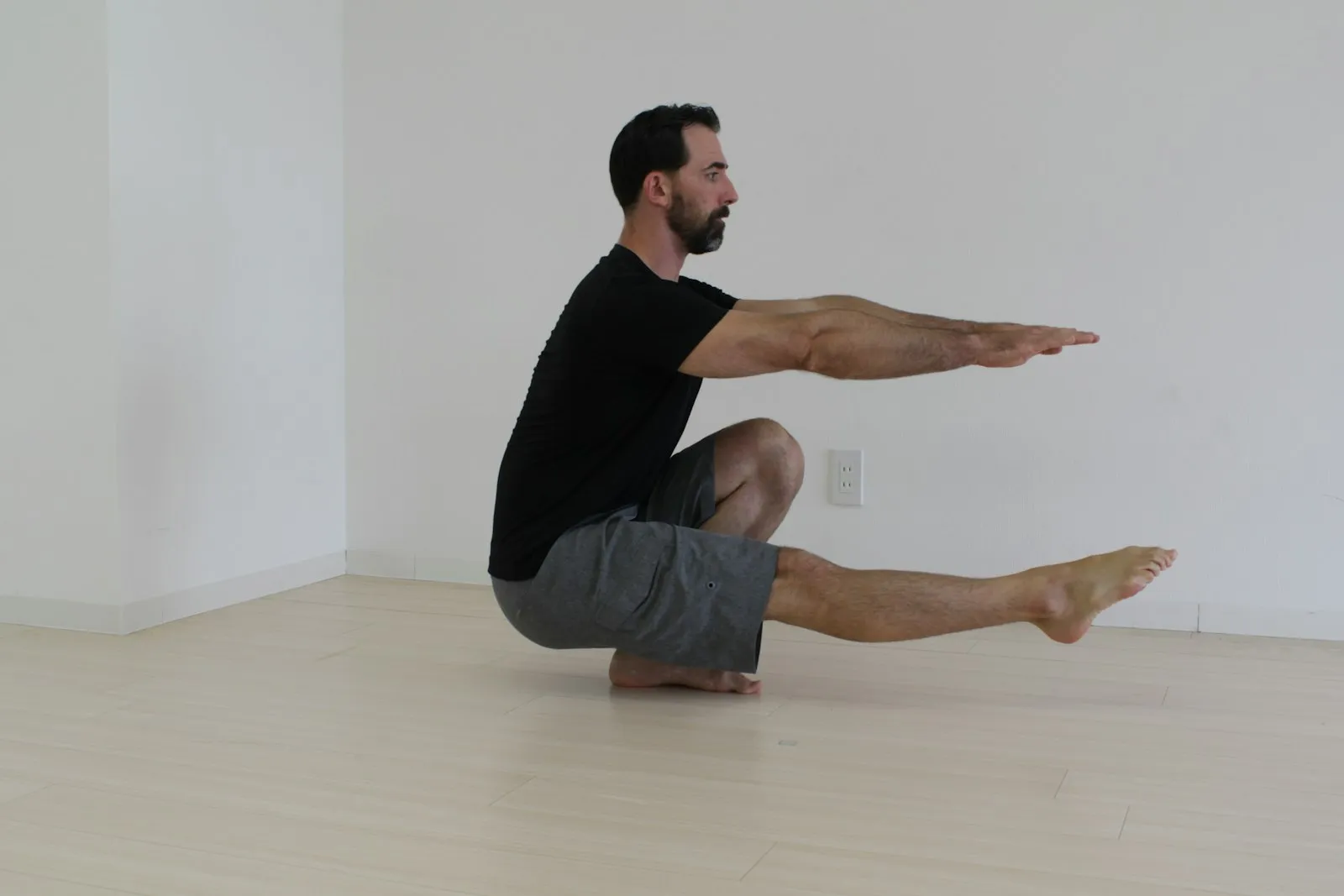
Can't do a pistol squat yet? Find your weak link, then follow box, assisted, counterweight and bench pistols up to a full single-leg squat, with an 8-week plan.
Ask anyone who trains with bodyweight what their legs routine lacks, and the answer is usually load. Squats get easy, lunges get easy, and then what? The pistol squat is the answer: a full squat on one leg, the other leg held straight in front, all the way down and back up. It loads one leg with your whole body weight, through a full range of motion, with no equipment at all.
It’s also a strange exercise to learn, because failing it rarely means your legs are too weak. More often you fall backwards, your heel lifts, or the free leg drops to the floor. So this guide starts with a diagnosis, then gives you a progression for each weak link.
The short answer: to learn a pistol squat, first check four things: single-leg strength, ankle mobility, a deep two-leg squat and the strength to hold your free leg up. Then progress through box pistols (lowering the box over time), assisted pistols holding a pole, slow negatives, counterweight pistols and bench pistols, in 3 sets of 5–8 reps per leg, two or three times a week. With decent leg strength and ankles, many people get a first full rep within one to three months.
Not sure where to start or how often to train legs? Titan Mode builds a calisthenics plan around your goal, your schedule and the equipment you have, even if that’s just the floor and a chair.
Find your weak link first
A pistol needs four things at once. Test each, on both legs, and write down the results.
| Element | Test | Pass |
|---|---|---|
| Strength | Bulgarian split squat (rear foot on a chair) | 3 × 10 per leg, controlled |
| Ankle mobility | Knee-to-wall: foot about 10 cm from the wall, push the knee forward to touch it | Knee touches without the heel lifting |
| Depth and balance | Deep bodyweight squat, feet hip-width, arms forward | 30 s hold at the bottom, heels down |
| Free-leg strength | Sit on the floor, legs straight, lift one leg off the ground | 10 lifts per leg |
Whichever test you fail is your priority. Most beginners fail two: strength and ankle mobility. The progression below works on all four, but spend extra time on the ones you flagged.
What the pistol squat works
The pistol is a full squat on one leg, so the standing leg does all the work: the quadriceps extend the knee, the glutes extend the hip and, together with the glute medius on the side of the hip, stop the knee from caving in. The calves and the small muscles of the foot keep you balanced, the hip flexors of the free leg hold it up in front, and the core stops your torso from collapsing forward or tipping back.
That combination is what makes it valuable for bodyweight training. A two-leg squat with only your body weight soon stops being hard; a pistol doubles the load on each leg without any equipment, through a full range of motion. It also exposes left-right differences that two-leg squats hide. On its own, though, it doesn’t cover the hamstrings (pair it with the Nordic hamstring curl) or the calves: our calisthenics leg workout shows where the pistol fits in a complete leg session.
The strength track
This is the main line of the progression. Work in 3 sets of 5 to 8 reps per leg, with 90 seconds rest. Move on when you hit 3 × 8 clean reps.
1. Box pistol
Stand in front of a box, bench or sturdy chair, about knee height. Lift one leg forward and sit down slowly on the box on the standing leg, then stand back up without rocking.
- Lower in 3 seconds: the descent is where the strength is built.
- Arms reach forward as a counterbalance.
- Knee tracks over the toes, not inward.
Each week or two, lower the box: a thick book or a folded mat on a lower step works. When you can sit on a box about a hand’s height above full depth, you’re close.
2. Assisted pistol
Hold a pole, a door frame, a TRX or the uprights of a street workout rig. Do full-range pistols, using your arms as little as possible. The aim is to own the bottom position: hips low, heel down, free leg in front.
A good drill here is a 2-second pause at the bottom of each rep. If you can pause, you’re controlling it; if you collapse, you need more box work.
3. Pistol negatives
Without assistance, lower yourself on one leg as slowly as possible to the bottom, then sit down or put the other foot down and stand up on two legs. 3 × 3–5 per leg, aiming for a 5-second descent.
4. Counterweight pistol
Hold a light weight at arm’s length in front of you: a 2–5 kg plate, a water bottle pack, a full backpack. The counterweight shifts your centre of mass forward and makes it much easier to stay balanced at the bottom. It sounds like cheating; it’s actually one of the best ways to learn the movement pattern.
Reduce the weight over the weeks until you’re using nothing.
5. Bench pistol
Stand on the edge of a bench or a step on one leg, the free leg hanging down off the side. Squat down until your hips are below the bench level. The free leg no longer needs to be held up in front, so you can isolate strength and balance. It’s also a nice variation to keep once you have a full pistol.
6. Full pistol
Free leg straight in front, heel just off the floor, all the way down and up. Start with singles on each leg, then 3 × 3, then 3 × 5.
Technique: how to do a pistol squat
Once you’re working on full or nearly full reps, these cues make the difference between a rep you control and one you fall out of:
- Set up. Stand on one foot, the whole foot flat on the floor, toes pointing forward or slightly out. Lift the other leg a few centimetres in front of you.
- Arms forward. Reach both arms straight ahead at shoulder height. They’re your counterbalance, and the further forward they go, the easier the bottom position becomes.
- Sit back and down. Push your hips back as you bend the knee, keeping the heel down. The knee travels forward over the toes: that’s normal and necessary.
- Raise the free leg as you go. The deeper you go, the higher the free leg has to be. Keep it straight and actively lift it rather than letting it hang.
- Torso leaning forward. A forward lean keeps your centre of mass over your foot. Trying to stay upright is the classic way to fall backwards.
- Own the bottom. Hamstring touching the calf, heel down. Pause for a moment rather than bouncing.
- Drive up through the whole foot. Push the floor away, knee tracking over the toes, and stand all the way up before the next rep.
Breathe in on the way down, hold your breath briefly through the bottom to stay tight, and breathe out as you pass the hardest point on the way up.
Common mistakes
- Falling backwards at the bottom. Usually ankle mobility or not leaning far enough forward. Reach your arms further, use a counterweight, or put a small lift under your heel while you work on the ankle.
- The heel lifting. Same cause: stiff ankles. Ankle rocks and deep squat holds are the long-term fix.
- The knee caving in. A sign the glutes are losing the fight. Slow down, use a higher box, and add side-lying leg raises or banded walks.
- The free foot dragging on the floor. The hip flexors of the free leg are giving up. Seated leg lifts fix this, and a bench pistol lets you train around it meanwhile.
- Rounding the lower back and bouncing. Diving into the bottom and rebounding out of it takes the strength work away from the muscles and puts it on the joints. Control the descent.
- Progressing on the strong leg only. Train the weaker side first and keep both legs on the same step.
The mobility and balance track
Do these 5 to 10 minutes before your leg work, or on off days:
- Ankle rocks: in a half-kneeling position, push the front knee forward over the toes and back, heel down. 2 × 15 per side. This is the single most useful drill if you failed the knee-to-wall test.
- Deep squat hold: 3 × 30–60 s, heels down. Hold a door frame at first if needed.
- Seated leg lifts: 2 × 10 per leg, legs straight, lifting from the hip. This strengthens the hip flexors that hold the free leg up.
- Single-leg balance: 3 × 30 s per leg, eyes open, then eyes closed.
If your ankles are stiff, a small heel lift under the standing foot (a folded mat, a weight plate) is a legitimate temporary fix while your mobility improves.
An 8-week plan
Train legs two or three times a week, never on consecutive days. Combine the strength track with the mobility drills.
| Weeks | Main exercise | Extra work |
|---|---|---|
| 1–2 | Box pistol at knee height, 3 × 5–8 | Bulgarian split squats 3 × 10, ankle rocks |
| 3–4 | Lower box + assisted pistol, 3 × 5 | Deep squat hold, seated leg lifts |
| 5–6 | Pistol negatives 3 × 3–5 + counterweight pistol 3 × 5 | Single-leg bridges 3 × 12 |
| 7–8 | Counterweight with less load, first unassisted attempts | Bench pistol 3 × 5 |
Your timeline may be shorter or longer. Ankle mobility in particular can take weeks to improve, so don’t judge your progress only by the box height.
Track the reps and box height for each leg. Most people have a weaker side; give it the first set each session, and don’t let the strong side race ahead by more than a step. A notebook works; so does an app. In Titan Mode, you log your reps set by set and follow a rest timer, so the numbers for each leg are there when you decide to lower the box.
Knees, hips and how to stay out of trouble
Healthy knees handle the pistol well when the load increases gradually. Trouble comes from three habits:
- The knee caving in. Keep it lined up with your second and third toes, the whole way down and up.
- Dropping into the bottom. A controlled descent protects the knee and builds more strength. If you can’t control it, use a higher box.
- Too many reps too soon. The pistol loads one leg with your entire body weight. Three to four hard sets per leg, twice a week, is plenty at first. Overall training volume drives progress, but ramp it up over weeks, not sessions.
Mild muscle soreness in the thighs and glutes is expected. Pain at the front of the knee, under the kneecap, or on the inside of the knee is a signal to reduce depth and volume. If you have a knee injury or condition, or pain that lasts more than a week or two, ask a physiotherapist or doctor before continuing.
Where the pistol fits in your training
The pistol is a squat pattern, so it replaces rather than adds to your other squat work. A balanced legs session might pair it with a hip hinge (single-leg glute bridges, single-leg Romanian deadlifts with no weight) and calf raises. If you train at home, our no-equipment calisthenics workout shows how to build a complete session around it, and our beginner calisthenics program gives the progression that comes before box pistols.
Legs are also the area where calisthenics is often said to fall short of the gym. The pistol is the strongest counter-argument, but it’s not the whole story: our honest comparison of calisthenics vs the gym covers when adding weights makes sense. And if you’re training outdoors, the poles and low bars of a street workout park make perfect supports for assisted pistols: see our guide to starting street workout. For your upper body, the same step-by-step logic applies to the muscle-up: prerequisites first, then drills, then the full move.
One leg at a time, with a plan
The pistol rewards small, regular steps: a lower box, a lighter counterweight, a longer pause at the bottom. Titan Mode builds your weekly plan around your goal, your schedule and the equipment you actually have, even if that’s only the floor and a chair. Every exercise comes with a demo and coaching cues, you log your reps and follow the rest timer, and you can swap an exercise when you need an easier or harder variation.
This article is general information, not medical advice. If you have a medical condition, an injury, pain or are pregnant, talk to a health professional before changing your training or diet.
FAQ
Why can't I do a pistol squat even though my legs are strong?
Because the pistol is as much about ankle mobility, balance and holding the free leg up as it is about leg strength. Many strong lifters fall backwards at the bottom. Test each element separately and train the one that fails.
Is the pistol squat bad for your knees?
Not for healthy knees trained progressively. Problems usually come from too much volume too soon, letting the knee cave inward, or dropping into the bottom without control. If you have a knee condition or pain that doesn't settle, check with a professional first.
How long does it take to learn a pistol squat?
With the prerequisites in place, many people get a first rep within one to three months of practice two or three times a week. Starting from weaker legs or stiff ankles, it can take longer.
Should I do pistol squats barefoot or in shoes?
Either works. A shoe with a slightly raised heel makes the bottom position easier if your ankles are stiff. Barefoot is a good test of balance and ankle mobility. Pick one and stay consistent while you progress.
Are pistol squats enough to train legs with bodyweight?
They're one of the best bodyweight leg exercises, but a complete leg routine also needs hip hinging and hamstring work, such as single-leg bridges or Nordic curl progressions, and some calf work.