Bodyweight Squat: Proper Form, Muscles Worked, Variations
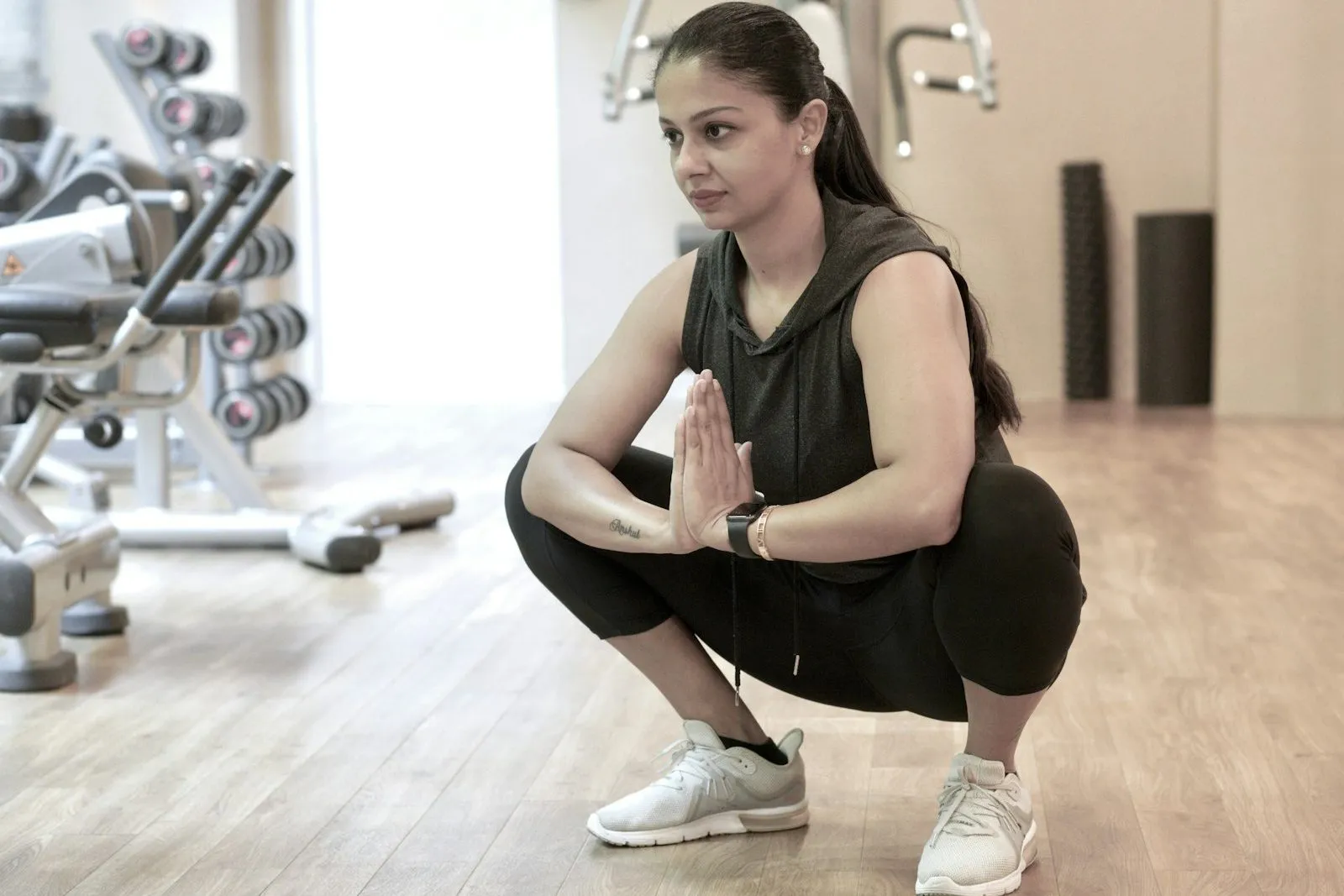
How to do a bodyweight squat with good form: stance, depth, knees, muscles worked, 10 variations from box squat to pistol, common mistakes and a 6-week plan.
The bodyweight squat (also called the air squat) is the first leg exercise almost everyone learns, and one of the most useful: you squat every time you sit down, stand up or pick something off the floor. Done well, it trains your quads, glutes and adductors, builds the mobility you need for harder leg exercises and costs nothing but a bit of floor.
The short answer: stand with your feet about shoulder-width apart, toes turned out 10 to 30 degrees. Brace your trunk, then bend your hips and knees together and sit down between your heels, keeping your whole foot on the floor and your knees pointing the same way as your toes. Go as low as you can with your heels down and your back neutral (thighs at least parallel to the floor is a good target), then push the floor away to stand up. Start with 2 to 3 sets of 10 to 15 reps, two or three times a week. When 3 sets of 20 to 25 reps feel easy, don’t keep adding reps: move to a harder version.
Below: step-by-step form, the muscles worked, how deep to go, the knee question, ten variations from easiest to hardest, the most common mistakes, a 6-week plan and safety notes. If you’d rather have your squats placed in a full weekly plan that moves you to the next variation at the right time, Titan Mode builds your calisthenics program from your level, your schedule and your equipment.
How to do a bodyweight squat, step by step
- Stance. Feet about shoulder-width apart, toes turned out slightly. People with longer thighs or stiffer hips often squat better a little wider with more toe-out. Spend a few reps finding the stance where you can go deepest with your heels down.
- Arms. Reach them forward as you go down, or clasp your hands in front of your chest. Both act as a counterweight and make it easier to stay balanced.
- Brace. Take a breath into your belly and tighten your trunk as if someone was about to poke your stomach. Keep your chest open, not puffed up.
- Descend. Bend the hips and knees at the same time. Think “sit down between your heels” rather than “sit back on a chair”, which makes many beginners fall backward. Your weight stays over the middle of the foot.
- Knees. Let them travel forward and slightly out, following your toes. They should not cave inward.
- Depth. Go down as far as you can control with your heels on the floor and no rounding of the lower back. For most people that is at least thighs parallel to the floor; many can go deeper.
- Stand up. Push the floor away with the whole foot, hips and chest rising together, and finish tall with the glutes squeezed. Breathe out on the way up or at the top.
A good rhythm for beginners: two to three seconds down, a brief pause at the bottom, one second up. Slower is harder and teaches control.
Muscles worked
| Muscle | Role in the squat |
|---|---|
| Quadriceps (front of the thigh) | Straighten the knee: the main movers, especially in the bottom half |
| Gluteus maximus | Extend the hip; works more as you go deeper |
| Adductors (inner thigh) | Help extend the hip from the bottom position |
| Hamstrings | Stabilise the knee and hip; worked much less than in a hinge or a curl |
| Calves | Control the forward travel of the knees and keep you balanced |
| Trunk (abs, obliques, spinal erectors) | Keep the spine neutral and the torso steady |
Squat biomechanics reviews describe the quads and glutes as the prime movers, with the hamstrings mainly acting as stabilisers (Schoenfeld, 2010; Straub and Powers, 2024). That’s why a squat on its own doesn’t make a complete leg workout: pair it with a hip hinge such as the glute bridge and a hamstring curl such as the Nordic hamstring curl.
How deep should you squat?
Deeper is generally better if you can control it. In a 10-week training study, people who trained with full squats gained more gluteus maximus and adductor volume than people who trained with half squats, while gains in the quadriceps were similar (Kubo et al., 2019). A review of squat depth also concluded that deep squats, done with proper technique, do not carry a higher risk for the knee than shallower squats, contrary to a common belief (Hartmann et al., 2013).
Practical rule: squat as deep as you can while your heels stay on the floor and your lower back doesn’t round. If that’s above parallel at the moment, work on it rather than forcing it. A bench or chair behind you (box squat) gives you a target, and elevating your heels on a thin plate or book is a legitimate temporary fix for stiff ankles.
Should your knees go past your toes?
This is the most common squat question, and the short answer is: they can, and in a deep squat they usually will. Analyses of the squat show that restricting forward knee travel reduces stress on the knee a little but increases it at the hips and lower back, and forces the torso to lean much further forward (Schoenfeld, 2010; Escamilla, 2001). What matters more is the direction of the knee (over the toes, not caving inward), keeping the heels down and staying pain-free.
If your knees are sensitive, take a slightly wider stance, slow the descent and use a box at a height that feels comfortable, then lower it over the weeks.
Bodyweight squat variations, easiest to hardest
Pick the version you can do for 8 to 20 clean reps. When you can do 3 sets at the top of that range, move to the next one. This is the basic progression principle of strength training: increase the difficulty when the current load becomes easy (ACSM, 2009).
- Supported squat. Hold a door frame, a table or a TRX in front of you and squat while your arms take a bit of weight. Good for beginners, older adults and anyone rebuilding confidence after an injury.
- Box squat. Squat down to touch a chair or bench lightly, then stand without rocking. Lower the box over time.
- Bodyweight squat. The standard version above.
- Prisoner squat. Hands behind your head, elbows wide. It makes your upper back work to keep the chest up and is a good test of posture.
- Tempo or paused squat. Four seconds down, a two- to three-second pause at the bottom. This alone makes 12 reps feel like 30.
- Jump squat. Squat to parallel and jump, landing softly with bent knees. It trains power rather than strength; keep reps low (5 to 8) and land quietly.
- Cossack squat. Wide stance, shift into one leg until it’s fully bent while the other stays straight. Adds adductor work and hip mobility.
- Split squat and Bulgarian split squat. One leg does most of the work. The Bulgarian version, back foot on a bench, is often the best bodyweight leg exercise for strength and muscle.
- Shrimp squat. On one leg, hold the other foot behind you and lower until the back knee touches a cushion.
- Pistol squat. A full single-leg squat with the free leg in front. Our pistol squat progression breaks it down into steps from the box pistol to the full version.
Two-legged squats get easy within a few weeks for most people. That’s not a problem: light loads can build similar muscle to heavy loads as long as sets are taken close to failure (Schoenfeld et al., 2017), and single-leg variations are how you keep the sets hard without adding weight. For the full picture of bodyweight leg training, including hamstrings and calves, see our calisthenics leg workout. And if moving squats bother your knees for now, the wall sit trains the same quads without moving the knee.
Common mistakes
- Heels lifting. Usually tight ankles or weight too far forward. Widen the stance a little, turn the toes out more, or raise the heels on a thin book while you work on ankle mobility.
- Knees caving inward. Push the knees out over the toes on the way up. If it keeps happening, slow down and use a box; glute bridges and side-lying leg raises help.
- Hips shooting up first. The chest drops and the squat turns into a good morning. Think “chest and hips rise together”.
- Lower back rounding at the bottom (often called “butt wink”). A small amount at full depth is common; a lot means you’re going deeper than your hips or ankles allow for now. Stop just above that point.
- Bouncing out of the bottom. Use a controlled descent and a short pause, at least while you learn.
- Only doing more reps. 200 easy squats builds endurance, not much strength. Make the variation harder instead.
- Holding your breath for long sets. Brace, but breathe out at the top of each rep.
A 6-week bodyweight squat plan
Two or three sessions a week, on non-consecutive days. Rest 60 to 90 seconds between sets. The last reps of each set should feel hard while your form stays clean.
| Week | Main squat | Sets × reps | Finisher |
|---|---|---|---|
| 1 | Box squat (or supported squat) | 3 × 10–12 | Glute bridge, 2 × 12 |
| 2 | Box squat, lower box | 3 × 12–15 | Glute bridge, 3 × 12 |
| 3 | Bodyweight squat | 3 × 12–15 | Reverse lunge, 2 × 8 per leg |
| 4 | Bodyweight squat | 3 × 15–20 | Reverse lunge, 3 × 8 per leg |
| 5 | Tempo squat (4 s down, 2 s pause) | 3 × 8–12 | Split squat, 2 × 8 per leg |
| 6 | Tempo squat, then test max clean squats | 2 × 10–12, then 1 max set | Split squat, 3 × 8–10 per leg |
After week 6, the natural next steps are lunges, Bulgarian split squats and the pistol squat progression. In a full-body routine, keep one squat or single-leg exercise per session, as in our 12-week calisthenics program for beginners. And if you have no equipment at all, the no-equipment home workout shows how squats fit alongside push-ups, rows and core work.
The hardest part of a plan like this is knowing when to move up. Titan Mode logs each set and shows every exercise in the session, and you can swap a squat variation for an easier or harder one when you need to, so your leg training keeps progressing instead of stalling at 20 easy reps.
How many squats a day? And the “100 squats challenge”
Daily squat challenges are popular, and for most healthy people they are safe if you build up gradually and keep the form clean. But they mostly train muscular endurance once the reps become easy. If your goal is stronger or more muscular legs, two or three harder sessions a week with progressing variations will do more. If your goal is simply to move more during a sedentary day, a few sets of 10 to 20 squats spread through the day is a great habit; just don’t expect it to replace structured training.
Safety and limits
- Knee pain. Pain that appears during the squat and persists usually means the load or depth is too much for now. Reduce the range, use a box, slow the descent. Persistent or sharp pain, swelling or locking should be seen by a doctor or physiotherapist.
- Hip or lower back pain. Shorten the range to where the back stays neutral, check that you’re not leaning far forward, and try a wider stance.
- Balance issues or older age. Start with the supported squat or the box squat, near a wall or a stable support.
- Pregnancy. Bodyweight squats are often kept in pregnancy exercise routines, but follow the advice of your midwife or doctor, particularly for depth and balance later on.
- After surgery or injury. Get clearance and a specific plan from your physiotherapist before loading the joint.
Squat well, then squat harder
A good bodyweight squat is simple: whole foot down, knees following the toes, trunk braced, as deep as you can control. Learn it with a box, own it for sets of 15 to 20, then make it harder with tempo and single-leg variations instead of endless reps. Paired with a hinge, some lunges, single-leg calf raises and a bit of core work such as our calisthenics abs workout, it’s the base of strong, capable legs. Want that progression planned for you? Download Titan Mode and start your calisthenics program.
This article is general information, not medical advice. If you have a medical condition, an injury, pain or are pregnant, talk to a health professional before changing your training or diet.
FAQ
What muscles do bodyweight squats work?
Mainly the quadriceps and the gluteus maximus, with the adductors (inner thigh) helping to extend the hip. The hamstrings, calves and trunk muscles stabilise. Deeper squats put more work on the glutes and adductors than half squats.
How do you do a bodyweight squat correctly?
Stand with your feet about shoulder-width apart and toes turned out slightly. Brace your trunk, then bend the hips and knees at the same time and sit down between your heels, keeping the whole foot on the floor and the knees in line with the toes. Go as low as you can while your heels stay down and your back stays neutral, ideally thighs at least parallel to the floor, then push the floor away to stand up.
How many bodyweight squats should I do?
Beginners can start with 2 to 3 sets of 10 to 15 reps, two or three times a week. Once you can do 3 sets of 20 to 25 clean reps, adding more reps mostly builds endurance: switch to a harder variation such as a tempo squat, a Bulgarian split squat or a pistol squat progression to keep building strength.
Is it OK to do 100 bodyweight squats a day?
For most healthy people it is safe if the form stays clean and you build up to it, but it is not the most efficient way to get stronger. After a few weeks, 100 easy squats becomes endurance work. Two or three harder leg sessions a week with progressively harder variations will build more strength and muscle.
Should my knees go past my toes when I squat?
They can. In a deep squat most people's knees travel past their toes, and that's normal. What matters is that the knees follow the direction of the toes, the heels stay down and the movement is pain-free. Blocking the knees behind the toes shifts more stress to the hips and lower back.
Can bodyweight squats build muscle?
Yes, at first and as long as the sets are hard. Research shows that light loads can build similar muscle to heavy loads when sets are taken close to failure. Bodyweight squats become too easy for that within a few weeks, which is why you move to slower tempos and single-leg variations.
Are bodyweight squats good for weight loss?
They help as part of a full-body strength routine because they work some of the largest muscles in the body, but no single exercise burns belly fat. Fat loss depends mainly on a moderate calorie deficit; squats and other strength exercises help you keep your muscle while you lose fat.
Sources
- Schoenfeld B.J. (2010). Squatting kinematics and kinetics and their application to exercise performance. J Strength Cond Res, 24(12), 3497–3506.
- Escamilla R.F. (2001). Knee biomechanics of the dynamic squat exercise. Med Sci Sports Exerc, 33(1), 127–141.
- Hartmann H., Wirth K., Klusemann M. (2013). Analysis of the load on the knee joint and vertebral column with changes in squatting depth and weight load. Sports Med, 43(10), 993–1008.
- Kubo K., Ikebukuro T., Yata H. (2019). Effects of squat training with different depths on lower limb muscle volumes. Eur J Appl Physiol, 119(9), 1933–1942.
- Straub R.K., Powers C.M. (2024). A biomechanical review of the squat exercise: implications for clinical practice. Int J Sports Phys Ther, 19(4), 490–501.
- Schoenfeld B.J. et al. (2017). Strength and hypertrophy adaptations between low- vs. high-load resistance training: a systematic review and meta-analysis. J Strength Cond Res, 31(12), 3508–3523.
- American College of Sports Medicine (2009). Position stand: progression models in resistance training for healthy adults. Med Sci Sports Exerc.