Lunges: How to Do Them, Muscles Worked, Variations
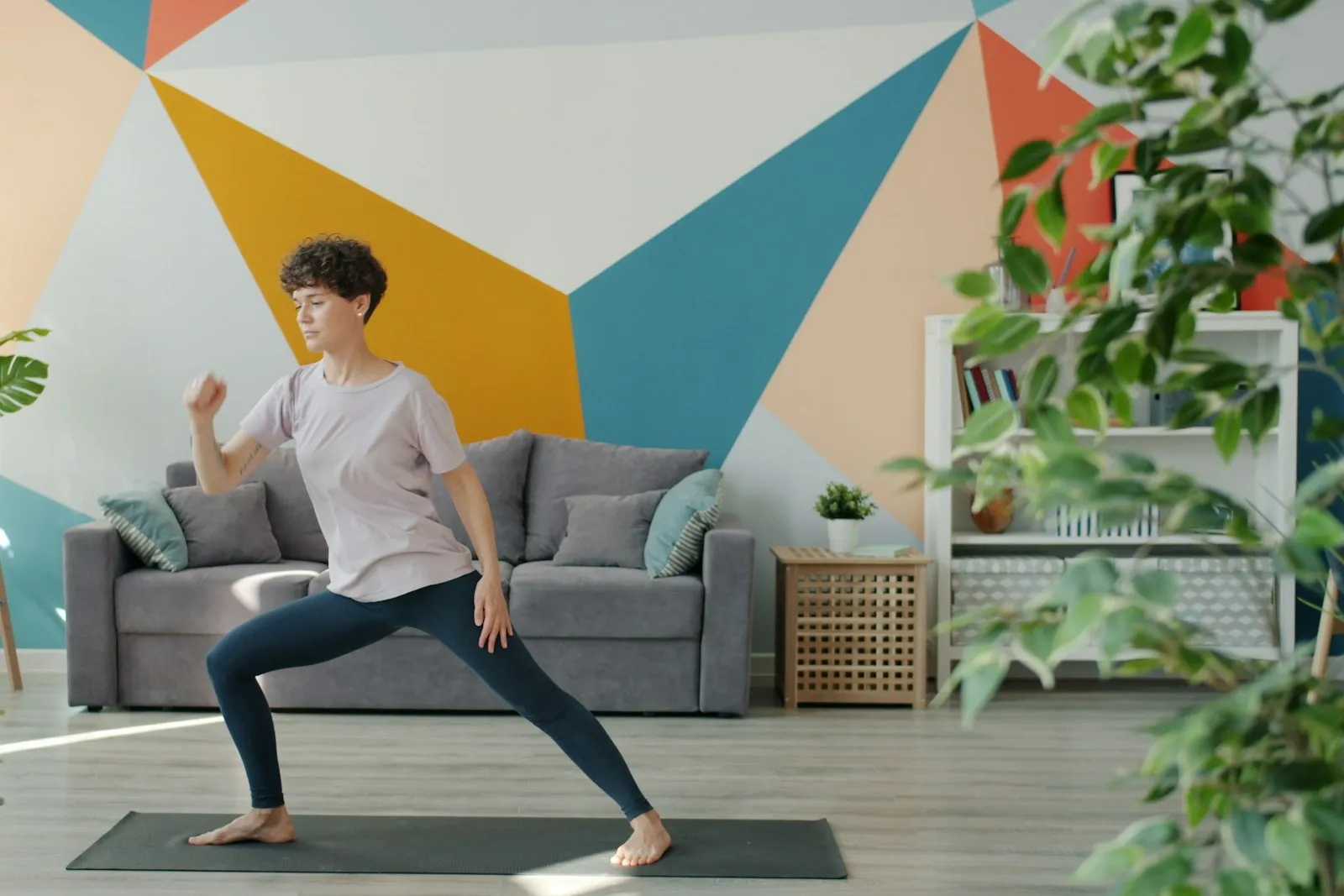
How to do a lunge with good form: step length, knee position, muscles worked, forward vs reverse vs walking lunges, common mistakes and a 6-week plan.
The lunge is one of the oldest leg exercises there is, and one of the most useful. It trains one leg at a time, needs no equipment, and teaches the balance and control you use every time you climb stairs, run or get up off the floor. Done well, it builds the quads and the glutes. Done badly, it wobbles, pinches the knee and feels pointless. The difference is mostly step length, foot width and where your weight sits.
In short: stand tall, feet hip-width apart. Take a long step (forward or back), then lower straight down until your back knee almost touches the floor and both knees are bent to about 90 degrees. Keep your front knee in line with your toes and your weight over the middle of the front foot, then push through the whole front foot to come back up. Start with reverse lunges: 3 sets of 8 to 12 reps per leg, two or three times a week. When you can do 15 clean reps per leg, move to walking lunges, deficit lunges or a slower tempo.
Below: the muscles worked, the exact technique, the five main variations and when to use each, the mistakes that make lunges hurt, a progression from supported lunges to jumping lunges, and a six-week plan. If you’d rather have lunges placed in a full week of training, Titan Mode builds a calisthenics plan around your level, schedule and equipment, with guided sessions and exercise previews.
What is a lunge?
A lunge is a single-leg squat pattern with a step. You move one foot forward, back or to the side, sink until the back knee is close to the floor, then return. Most of your weight goes through the front leg, which bends at the knee and hip and then straightens to lift you.
Three things make it different from a regular bodyweight squat:
- One leg does most of the work. That makes it hard enough to build strength without weights, at least for the first months.
- You have to balance. The narrow base forces the side of the hip and the trunk to keep you steady, which is why lunges carry over well to running and sports.
- The step adds a braking phase. In a forward or walking lunge, the front leg has to stop your body’s momentum before it lowers you. That’s useful training, and also what makes forward lunges harder on the knee.
Lunges belong to the same family as the split squat (both feet stay planted) and the Bulgarian split squat (back foot on a bench). In our calisthenics leg workout, they sit between the bodyweight squat and those harder single-leg exercises.
Muscles worked
- Quadriceps (front leg): they straighten the knee and work hardest at the bottom.
- Gluteus maximus (front leg): it extends the hip as you stand up.
- Adductors: the inner thigh muscles help extend the hip from the bottom position.
- Gluteus medius and minimus: on the side of the hip, they keep the pelvis level and stop the knee from caving in.
- Hamstrings and calves: stabilisers, with a small role in the lift.
- Back leg: its quads and hip flexors control the descent and stretch at the bottom.
- Trunk: the abs and back muscles keep you upright.
What does the research say? A biomechanics study of the forward lunge found it to be hip-extensor dominant, and adding load mostly increased the work at the hip and ankle, with little change at the knee (Riemann et al., 2012). Another study showed that leaning the torso forward during a lunge increased the work of the hip extensors (glutes and hamstrings), while keeping the torso upright kept more of the work on the knee (Farrokhi et al., 2008). In practice: a long step and a slight forward lean for glutes; a shorter step and an upright torso for quads. A systematic review of glute activation also ranks lunges and other single-leg exercises among the useful options for the gluteus maximus (Neto et al., 2020).
How to do a lunge, step by step
These steps describe the reverse lunge, the best version to learn first.
- Stand tall with your feet hip-width apart, as if on two rail tracks, not one tightrope. Brace your abs lightly.
- Step back about two feet (60 to 90 cm, depending on your height), landing on the ball of the back foot.
- Lower straight down. Think “elevator”, not “escalator”: your hips go down, not forward. Stop when your back knee is a few centimetres above the floor.
- Check the bottom position. Front shin roughly vertical to slightly forward, front knee over the toes, about 90 degrees at both knees, weight over the middle of the front foot, torso tall or leaning slightly forward.
- Push through the whole front foot (heel and toes) and bring the back foot back to the start.
- Do all the reps on one side, then switch, or alternate legs. Count reps per leg.
Breathing: inhale on the way down, exhale as you push up.
Tempo: two seconds down, a short pause just above the floor, one second up. Slow, controlled reps are what make a bodyweight lunge hard enough to build muscle.
Lunge variations: which one to choose
| Variation | What changes | Best for |
|---|---|---|
| Reverse lunge | Step back | Learning, knee-friendly, glutes |
| Forward lunge | Step forward, then push back | Braking strength, sports |
| Walking lunge | Step forward continuously | Endurance, coordination, quads |
| Side (lateral) lunge | Step to the side, other leg straight | Adductors, hip mobility |
| Curtsy lunge | Step back and across | Side of the hip (gluteus medius) |
| Deficit reverse lunge | Front foot on a 5–15 cm step | More range, more glutes |
| Jumping lunge | Switch legs in the air | Power, conditioning |
Reverse vs forward lunges. The reverse lunge is easier to control because the front leg never has to stop your momentum. If forward lunges bother your knees, reverse lunges almost always feel better. The forward lunge is still worth learning later, because the braking phase matters for running and change of direction.
Walking lunges make you balance on every rep and get the heart rate up fast. They’re great as a finisher or in a circuit, less precise for counting hard reps.
Side lunges are a different movement: you sit back into one hip while the other leg stays straight. They train the adductors and open the hips, which the other lunges barely do.
Common mistakes and how to fix them
- Step too short. The front heel lifts and the knee shoots far forward. Fix: take a longer step until your front shin is close to vertical at the bottom.
- Step too long. The back knee barely bends and you can’t get low. Fix: shorten the step until both knees reach about 90 degrees.
- Feet on a tightrope. One foot directly in front of the other makes you wobble. Fix: keep your feet hip-width apart, front to back.
- Knee caving inward. Fix: push the front knee gently out over the middle toes, slow down and lower the range if needed.
- Pushing off the back foot. The back leg does the work and the front leg rests. Fix: think “the front foot lifts me”, and keep 70 to 80% of your weight on it.
- Slamming the back knee. Fix: stop a few centimetres above the floor, or place a folded towel under it while you learn.
- Rounding forward. A slight forward lean is fine; collapsing over the front thigh is not. Keep your chest proud and your back straight.
Progression: from first lunge to jumping lunges
Move to the next step when you can do 3 sets of 12 to 15 clean reps per leg with a controlled tempo.
- Supported split squat: both feet planted, one hand on a wall or a chair.
- Split squat: same, no support.
- Supported reverse lunge: step back, one hand on a wall.
- Reverse lunge: no support.
- Forward lunge and walking lunge.
- Deficit reverse lunge: front foot on a low step, for a deeper range.
- Slow-tempo or pause lunges: three seconds down, two-second pause at the bottom.
- Bulgarian split squat: back foot on a bench.
- Jumping lunges, once the strength steps feel easy and your knees are happy, then towards the pistol squat.
Adding a loaded backpack is a good option at steps 4 to 8. You can also hold a water bottle or a bag in each hand.
How many lunges, and how often?
For strength and muscle, the general guidelines for resistance training apply (ACSM, 2009): 2 to 4 sets of roughly 6 to 15 reps, two or three times a week, and progress when the reps get easy. With bodyweight, “progress” means a harder variation, a slower tempo or more range rather than just more reps. Stop each set one to three reps before failure.
For conditioning, walking lunges or jumping lunges in timed sets (30 to 45 seconds) work well inside a circuit.
Rest one day between hard leg sessions. Lunges cause a lot of soreness at first because they stretch the glutes and quads under load, so start with fewer sets than you think you need.
A six-week lunge plan
Twice a week, for example Monday and Thursday. Start with the variation that matches your level.
| Week | Main lunge | Sets × reps per leg | Extra |
|---|---|---|---|
| 1 | Reverse lunge (supported if needed) | 2 × 8 | 2 × 12 glute bridges |
| 2 | Reverse lunge | 3 × 8 | 3 × 12 glute bridges |
| 3 | Reverse lunge | 3 × 10–12 | 2 × 8 side lunges |
| 4 | Walking lunge | 3 × 10–12 | 2 × 10 side lunges |
| 5 | Deficit reverse lunge, slow tempo | 3 × 8–10 | 3 × 10 single-leg glute bridges |
| 6 | Bulgarian split squat or loaded reverse lunge | 3 × 8–10 | 2 × 30 s walking lunges |
Warm up first with a few bodyweight squats, leg swings and ten easy lunges. Pair this with a hinge (such as the glute bridge) and a hamstring exercise such as the Nordic curl, because lunges alone leave the back of the leg undertrained.
Want this as part of a full week, with upper-body days, rest days and your progress tracked automatically? Get a personalised plan in Titan Mode: you answer three questions, and the app builds your sessions exercise by exercise.
Safety and limits
- Knee pain at the front of the knee: switch to reverse lunges, shorten the range, lean slightly forward, and slow down. If pain persists, see a physiotherapist.
- Balance problems: hold a wall or a chair. Losing balance is a skill issue, not a strength issue, and it improves within a few sessions.
- Recent injury, surgery or pregnancy: ask a health professional which variations suit you.
- Jumping lunges are impact training. Keep them for when the basic lunge is easy, and land softly.
Lunges in a calisthenics routine
Lunges are a staple of any calisthenics workout at home. A balanced lower-body session might look like this: one squat pattern (squat or Bulgarian split squat), one lunge pattern, one hinge (glute bridge or single-leg hip thrust), one hamstring curl and one calf exercise such as single-leg calf raises. In a full beginner program, lunges usually appear once or twice a week on leg or full-body days.
This article is general information, not medical advice. If you have a medical condition, an injury, pain or are pregnant, talk to a health professional before changing your training or diet.
FAQ
What muscles do lunges work?
Mainly the quadriceps and the gluteus maximus of the front leg. The adductors help extend the hip, the gluteus medius keeps the pelvis level and the knee in line, and the hamstrings, calves and trunk stabilise. The back leg works less, but its quads and hip flexors still control the descent.
How do you do a lunge correctly?
Stand tall with your feet hip-width apart. Take a long step forward, then lower straight down until your back knee almost touches the floor and both knees are bent to about 90 degrees. Keep your front knee in line with your toes and your weight over the middle of your front foot. Push through the whole front foot to return to standing.
Are reverse lunges better than forward lunges?
For most beginners, yes. Stepping back lets you control the load on the front leg, so it's easier to balance and usually kinder to the knees. Forward lunges add a braking phase that is harder on the knee but useful for sport. Both work the same muscles.
How many lunges should I do a day?
You don't need to do them every day. Two or three sessions a week of 3 sets of 8 to 15 reps per leg, with the last reps feeling hard, is enough to build strength and muscle. If you want to train daily, keep most days light and save the hard sets for two or three days.
Should my knee go past my toes when I lunge?
It can. A little forward knee travel is normal and makes the quads work. What matters is that the knee tracks over the toes, does not cave inward and the movement is pain-free. To take load off the knee, take a longer step and lean your torso slightly forward.
Do lunges build glutes?
Yes. Lunges are hip-dominant, so the gluteus maximus does a lot of the work, especially with a longer step and a slight forward lean of the torso. For more glute work, use reverse lunges, deficit lunges and walking lunges, and pair them with glute bridges.
Lunge vs split squat vs Bulgarian split squat: what's the difference?
In a lunge you step on every rep, which adds balance and braking. In a split squat both feet stay in place. In a Bulgarian split squat the back foot rests on a bench, which puts more weight on the front leg and makes it the hardest of the three.
Sources
- Riemann B.L. et al. (2012). Biomechanical analysis of the anterior lunge during 4 external-load conditions. J Athl Train, 47(4), 372–378.
- Farrokhi S. et al. (2008). Trunk position influences the kinematics, kinetics, and muscle activity of the lead lower extremity during the forward lunge exercise. J Orthop Sports Phys Ther, 38(7), 403–409.
- Neto W.K. et al. (2020). Gluteus maximus activation during common strength and hypertrophy exercises: a systematic review. J Sports Sci Med.
- American College of Sports Medicine (2009). Progression models in resistance training for healthy adults. Med Sci Sports Exerc, 41(3), 687–708.