Street Workout for Beginners: How to Start
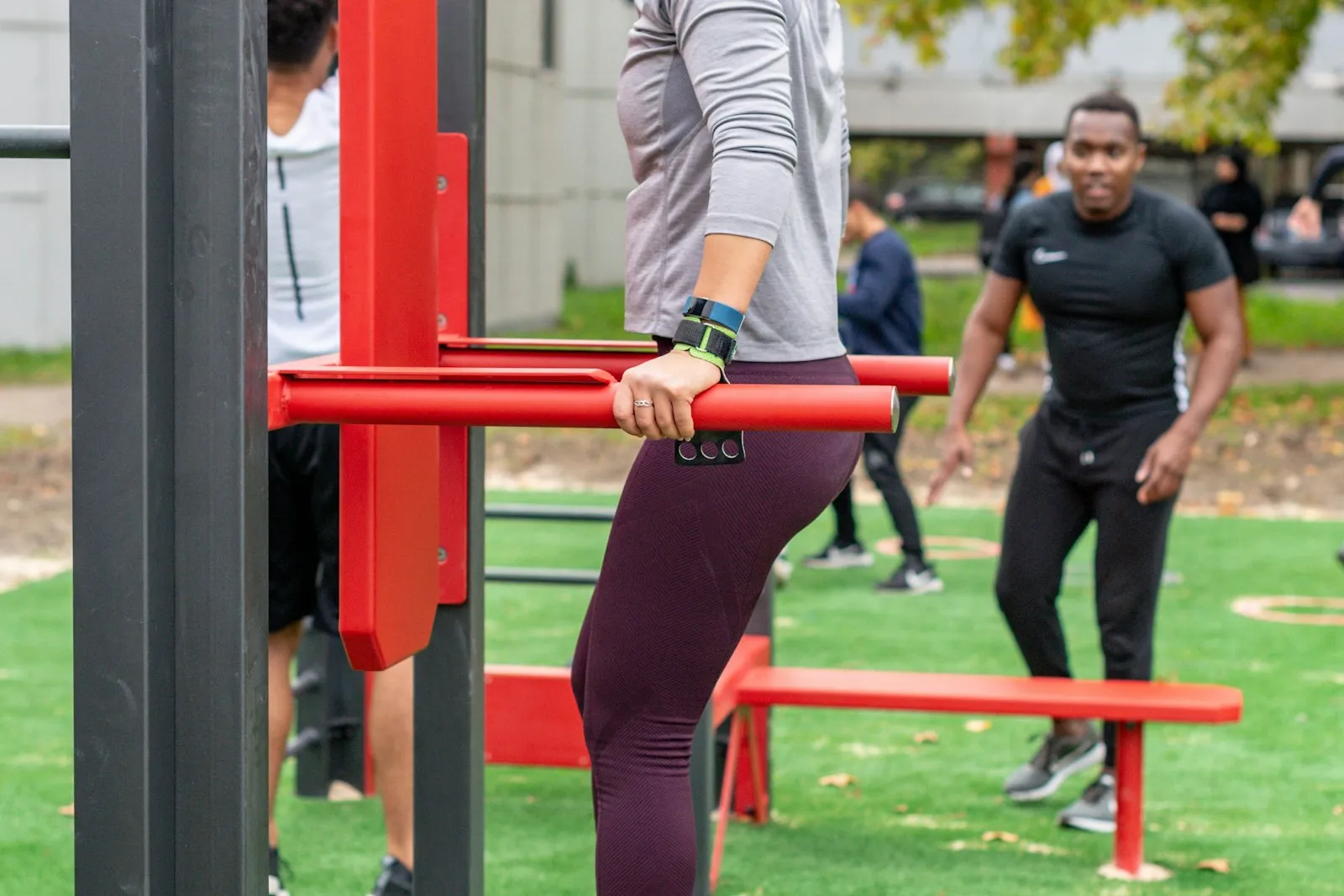
Street workout from zero: the vocabulary, the equipment, how to use an outdoor calisthenics park, a simple 3-day program and the safety rules.
Bars, parallel bars, a few benches, and people moving between pull-ups, dips and skills that seem to ignore gravity. Street workout is free, outdoors and fun to watch. It’s also intimidating: when you arrive at a park and can’t do a single pull-up, it’s hard to know where to begin.
This guide is for that moment. Below you’ll find the words you’ll hear, the equipment you need (very little), how to use an outdoor park as a beginner, a simple first program and the safety rules that keep you training for years. Each section links to a more detailed guide for when you’re ready to go further.
Street workout and calisthenics
Calisthenics covers all bodyweight exercise: push-ups, pull-ups, dips, squats, core work. Street workout is the outdoor, park-based side of it, with its own culture of static strength skills, freestyle (dynamic moves around the bar), competitions and a community that’s usually happy to help newcomers. For the origin of the word, the benefits and the full list of basic exercises, see our guide to what calisthenics is.
For a beginner, the distinction hardly matters. The basics are the same, and they work as well in a park as in your living room. What matters is progressing through variations, from easier to harder. And it works: in a 2018 study, four weeks of progressive push-up training increased bench press strength, just like bench press training itself did.
The vocabulary
You’ll hear these terms in your first session:
- Pull-up / chin-up: pulling your chin over the bar, palms facing away (pull-up) or toward you (chin-up).
- Australian pull-up: another name for the inverted row, under a low bar with your feet on the ground. The best back exercise to start with.
- Dips: lowering and pressing yourself up between parallel bars.
- Negative: doing only the lowering part of a movement, slowly, to build strength.
- Muscle-up: an explosive pull-up that transitions over the bar into a dip.
- Handstand: balancing on your hands with straight arms.
- L-sit: holding yourself up on your hands with straight legs out in front (see our L-sit progression).
- Front lever / back lever: holding your body horizontal under the bar, facing up (front) or down (back).
- Planche: a horizontal body supported on your hands, feet off the ground. Advanced.
- Human flag: holding your body sideways, horizontal, on a vertical pole (see our human flag progression).
- Tuck: the easier, knees-to-chest version of a skill.
- Kipping: using leg swing for momentum. Useful in freestyle, best avoided until you have strict strength.
- Statics vs dynamics: held positions (levers, planche, flag) vs moving tricks around the bar.
Equipment: less than you think
You can start with nothing at all: push-ups, squats, lunges, planks and pike push-ups make a complete session. Our calisthenics workout at home with no equipment gives you sessions by level.
After that, in order of usefulness:
- A pull-up bar, if you don’t have a park nearby. It unlocks all vertical pulling.
- Resistance bands, to assist pull-ups and dips while you build strength.
- Gymnastic rings, cheap and versatile, hung from a bar or a sturdy branch. Less stable, so harder.
- Parallettes, small floor bars that are kind to your wrists for push-ups, L-sits and handstand work.
Chalk and gloves are optional. Calluses are part of the deal; keep your hands clean and moisturized so they don’t tear.
To choose between doorway, wall-mounted and freestanding bars, or pick rings and bands, see our calisthenics equipment guide.
How to use an outdoor park
What you’ll find
Most outdoor calisthenics parks have the same modules: fixed bars at several heights, parallel bars, monkey bars, sometimes wall bars, an inclined bench and vertical poles. Search a map app for “street workout park” or “outdoor gym”, or check your city’s website: many towns have installed them in public parks.
A beginner’s map of the park
| Station | What to do there as a beginner |
|---|---|
| Low bar (hip to chest height) | Inverted rows. Walk your feet forward to make them harder. |
| High bar | Dead hangs, scapular pulls, negative pull-ups (jump or step up, lower slowly). |
| Parallel bars | Support holds, then negative dips, then full dips (dips progression). |
| Bench | Incline push-ups (hands on the bench), step-ups, Bulgarian split squats. |
| Monkey bars | Grip work: hangs and short traverses once your grip is solid. |
Etiquette and checks
Share the bars between sets, don’t leave your bag on them, and ask for tips: most regulars remember being beginners. Before you hang from anything, check it: a bar that moves or a loose module is a pass. Wet bars are slippery, bars in full sun can get hot, and winter bars are freezing. Those details matter when you’re hanging two meters off the ground.
Your first program: three sessions a week
Train three times a week on non-consecutive days, alternating Session A and Session B. End each set with one or two clean reps left in the tank.
Warm-up (8 to 10 minutes): one minute of jumping jacks or brisk walking, 10 arm circles each way, 10 scapular push-ups, 10 slow squats, a 20-second dead hang and some wrist circles.
Session A
| Exercise | Sets × reps | Rest |
|---|---|---|
| Inverted row on a low bar | 3 × 6–12 | 90 s |
| Push-up (incline if needed) | 3 × 6–12 | 90 s |
| Negative pull-up (5 s descent) | 3 × 3–5 | 2 min |
| Squat or lunge | 3 × 10–15 | 90 s |
| Hanging knee raise | 3 × 6–10 | 60 s |
Session B
| Exercise | Sets × reps | Rest |
|---|---|---|
| Support hold on parallel bars | 3 × 15–30 s | 90 s |
| Negative dip (3–5 s descent) | 3 × 3–5 | 2 min |
| Dead hang + scapular pulls | 3 × 20–40 s + 5–10 | 90 s |
| Pike push-up | 3 × 5–10 | 90 s |
| Reverse lunge | 3 × 8–12 per leg | 90 s |
| Plank | 3 × 20–45 s | 60 s |
Progression: use double progression. When you hit the top of the rep range on every set with clean form, move to the harder variation and start again at the bottom: incline push-ups to floor push-ups, negative dips to your first full dips, negative pull-ups to your first pull-ups. This is a park version of our 12-week calisthenics program for beginners, which covers every level in detail.
Milestones and where to learn them
| Goal | Typical timeframe for a consistent beginner | Guide |
|---|---|---|
| Clean push-ups in sets of 10 | A few weeks to 3 months | Push-up progression |
| First pull-up | 4 to 16 weeks | Your first pull-up |
| Chest-to-wall handstand, 45–60 s | 1 to 2 months | Handstand for beginners |
| First muscle-up | Several months, after 8–10 pull-ups and 10–15 dips | How to do a muscle-up |
These timeframes vary a lot with body weight, sports background and consistency. Skills like the front lever and planche come much later: build the base first, then follow a step-by-step front lever progression or planche progression when you get there.
Safety without drama
Street workout isn’t riskier than other sports if you respect a few rules:
- Warm up every session, especially shoulders and wrists.
- Respect your tendons. Muscles adapt faster than tendons, which need time and gradually increasing load. That’s why elbow pain often shows up when people ramp up pull-ups or dips too quickly.
- Don’t skip steps. Kipping muscle-ups or front lever attempts without a base are a short road to sore shoulders and elbows.
- Stop any exercise that hurts a joint. Muscle soreness in the first weeks is normal; sharp or worsening pain is not. If it persists, see a doctor or physiotherapist.
- Check with your doctor first if you have a health condition, an old injury, or haven’t exercised in years.
For general health, the World Health Organization recommends that adults get 150 to 300 minutes of moderate activity a week and do regular muscle-strengthening activity. Three street workout sessions cover the strength part; add walking or cycling for the rest.
Outside the park
You get stronger while recovering, not while training. Sleep 7 to 9 hours when you can, and eat enough protein (around 1.6 g per kg of body weight per day is a common recommendation for people who train) and enough food overall if you want to build muscle. Our calisthenics nutrition guide helps you set your targets. Still deciding between the park and a gym? Our comparison of calisthenics vs the gym helps you choose by goal.
Keep it simple, keep it going
The hardest part at the start isn’t the effort; it’s knowing what to do each session and when to move up. Titan Mode, the app we’re building, will create your calisthenics plan from three questions and the equipment you actually have, whether that’s a full outdoor park, a bar at home or just the floor, and guide you set by set. Until then, the program above is all you need for your first three months. Write everything down, show up three times a week, and come back to this page when you’re ready for the next milestone.
This article is general information, not medical advice. If you have a medical condition, an injury, pain or are pregnant, talk to a health professional before changing your training or diet.
FAQ
What is the difference between street workout and calisthenics?
Calisthenics is bodyweight training in general, wherever you do it. Street workout is its outdoor side, practiced on park bars, with its own culture of strength skills (muscle-up, front lever, planche) and freestyle. The fundamentals are exactly the same.
Can I start street workout if I can't do a pull-up?
Yes, most beginners can't. Start with dead hangs, scapular pulls, inverted rows on a low bar and negative pull-ups. The first pull-up usually comes within 4 to 16 weeks with two or three pulling sessions a week.
How often should a beginner do street workout?
Three full-body sessions a week on non-consecutive days is plenty. Tendons and joints need recovery time, and consistency over several months is what makes you progress.
What should I bring to the park?
Water, shoes with a stable sole and clothes you can move in. A resistance band is useful for assisted pull-ups and dips. Chalk and gloves are optional; calluses on your hands are normal.
Sources
- Bull et al. (2020), World Health Organization 2020 guidelines on physical activity and sedentary behaviour, Br J Sports Med
- Kotarsky et al. (2018), Effect of progressive calisthenic push-up training on muscle strength and thickness, J Strength Cond Res
- Magnusson & Kjaer (2019), The impact of loading, unloading, ageing and injury on the human tendon, J Physiol