What Is Calisthenics? Meaning, Benefits and Exercise List
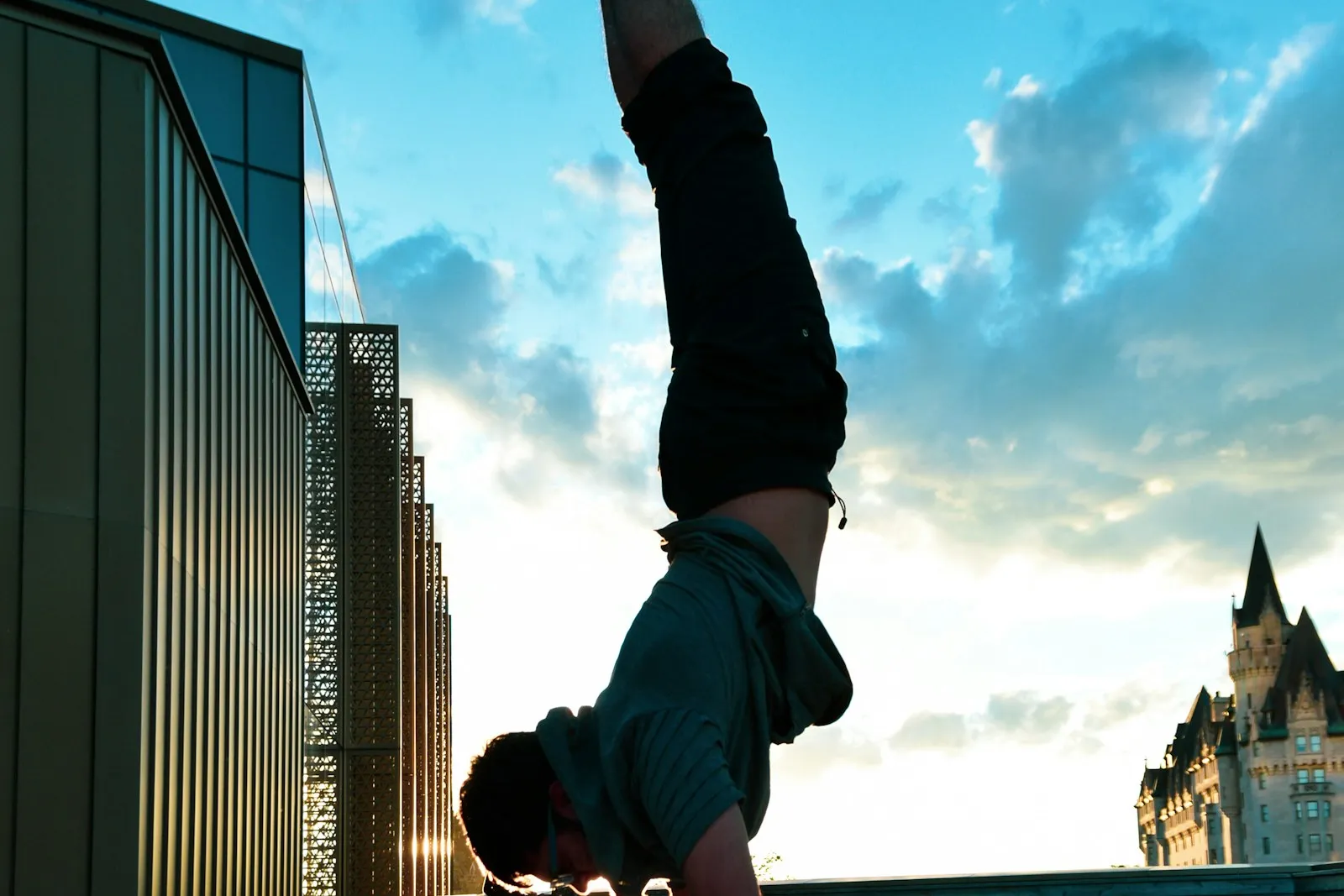
Calisthenics meaning: bodyweight strength training. Origin, benefits and limits, a list of 20 exercises, what it does to your body and how to start.
Calisthenics is strength training that uses your own body weight as resistance. Push-ups, pull-ups, dips, squats, lunges and planks are the foundations; skills like the handstand, the L-sit or the muscle-up come later. Instead of adding plates to a bar, you progress by switching to a harder variation (from an incline push-up to a full push-up, then a decline or archer push-up), by changing leverage and range of motion, or by doing more reps. It needs little or no equipment, it builds real strength and muscle, and its main limits are heavy leg work and maximal strength.
Calisthenics definition, in one line: a form of strength training where your body weight is the load and harder exercise variations replace heavier weights. The word means “beautiful strength” in Greek.
This guide explains where the word comes from, what calisthenics actually includes, what the research says about its benefits, the core exercises by level, the equipment worth buying and how to start this week. If you’d rather skip straight to training, Titan Mode builds a calisthenics plan around your goal, the days you can really train and the equipment you have, from a full park to just the floor.
Where the word “calisthenics” comes from
The word comes from two Greek roots: kalos, beautiful, and sthenos, strength. Merriam-Webster dates its first known use in English to 1827 and defines it as “systematic rhythmic bodily exercises performed usually without apparatus”. “Beautiful strength” is a good summary of what people still chase: being strong, but also moving well.
The practice is much older than the word. Bodyweight exercise was part of physical education in ancient Greece, and in the 19th century European and American schools adopted structured routines of free exercises. Armies did the same: “military calisthenics” (jumping jacks, push-ups, sit-ups done in formation) became the backbone of physical training because it needs no equipment and can be done by hundreds of people at once. Our guide to military calisthenics shows how armies still use it today, with a 4-week plan you can follow.
Modern calisthenics looks different. Since the 2000s, the street workout scene in outdoor parks has pushed it towards strength skills (muscle-ups, front levers, planches) and freestyle moves on the bar, and online coaching has popularised structured progressions. Today the word covers the whole range, from a beginner doing incline push-ups at home to an athlete holding a full planche.
What calisthenics includes (and what it doesn’t)
People use several overlapping words. Here’s how they relate:
| Term | What it means |
|---|---|
| Calisthenics | Bodyweight strength training in general, wherever you do it |
| Bodyweight training | A near synonym, often used for home workouts and circuits |
| Street workout | The outdoor, park-based side of calisthenics, with its own culture of skills and freestyle |
| Gymnastics | A competitive sport with apparatus and judged routines; calisthenics borrows many of its drills |
| Military calisthenics | Classic drills (jumping jacks, push-ups, sit-ups) done for conditioning |
| Weighted calisthenics | Pull-ups, dips and push-ups with a weight belt or vest, for advanced trainees |
What calisthenics is not: just high-rep cardio. Fast circuits of burpees and mountain climbers have their place, but a calisthenics program worth following is built like any strength program, with hard sets, a few key movements and a clear way to make each one harder over time. If you want to see that side up close, our guide to street workout for beginners explains how to use an outdoor park.
The main types of calisthenics training
Under the same word, people train in quite different ways. Knowing which one you’re looking at saves a lot of confusion when you compare programs online:
- Strength calisthenics. Few exercises, hard sets of 3 to 12 reps, long rests, and a clear ladder of harder variations. This is what builds muscle and strength, and it’s the core of most good programs.
- Skills (statics). Holds and controlled movements such as the handstand, L-sit, front lever, back lever and planche. They need a strength base first and are trained in short, fresh sets.
- Endurance and conditioning circuits. Push-ups, squats, mountain climbers and burpees chained with short rests. Great for fitness and time-efficient, but a weaker stimulus for strength.
- Freestyle (street workout). Dynamic and creative moves on the bar: swings, releases, spins. It’s closer to a sport than to a training method.
- Weighted calisthenics. Pull-ups, dips and squats with a belt or vest once bodyweight reps get too easy, like weighted pull-ups.
Most people start with strength calisthenics, add one or two skills after a few months, and use circuits as a finisher or on busy days.
How calisthenics makes you stronger
Your muscles don’t know whether the resistance comes from a barbell or your own body. They respond to mechanical tension: sets that are hard, taken close to failure, and made a little harder week after week. That’s progressive overload, and calisthenics applies it in four ways:
- Leverage. Moving your feet away from your hands, raising them, or straightening your legs makes the same movement much harder. A push-up with your hands on a table is far easier than one on the floor.
- Number of limbs. Going from two arms or legs to one (archer push-up, pistol squat, one-arm push-up) roughly doubles the load on the working side.
- Range of motion and tempo. Going deeper, pausing at the hardest point, or lowering in three to four seconds increases the time your muscles spend under tension.
- Reps and sets. The simplest lever: once you hit the top of your rep range, add reps or a set, then move to the next variation.
The research is consistent with this. In a randomised trial, progressive push-up training using harder variations every few weeks increased bench press strength as much as bench press training did over four weeks (Kotarsky et al., 2018). The study was small and short, but it’s exactly how calisthenics programs are built: you climb a ladder of variations instead of adding plates. We compare both methods in detail in calisthenics vs gym.
What about high reps? A meta-analysis comparing light and heavy loads found similar muscle growth when sets were taken close to failure, while heavy loads built more maximal strength (Schoenfeld et al., 2017). For calisthenics, the practical takeaway is simple: sets of 20 or 25 still build muscle if they’re genuinely hard, but once you pass about 20 to 25 clean reps, switching to a harder variation is the more efficient way to keep progressing.
The real benefits of calisthenics
Strength and muscle with almost no equipment
For beginners and intermediates, calisthenics builds strength and muscle very effectively, as long as the sets are hard and the variations get harder. In a 2026 randomised trial in adults with obesity, a 12-week calisthenics program improved grip, leg and back strength, flexibility and endurance, and reduced fat mass compared with a control group (Li & Huang, 2026). Results like these are about effort and consistency, not a special method, but they show the format works for people starting from a low base.
Strength relative to your body weight and body control
Pulling yourself over a bar or holding yourself on parallel bars trains strength relative to your body weight, along with coordination and core control. Those qualities carry over to everyday life and to other sports, and they’re the foundation of skills like the handstand or the muscle-up.
Low cost, train anywhere
A floor, a sturdy table, a door frame: that’s enough to start. A pull-up bar costs about as much as a month of gym membership, and outdoor parks are free. Fewer barriers mean more sessions actually happen, and over months consistency matters more than the perfect exercise selection.
Health, not just looks
The WHO recommends muscle-strengthening activity for all major muscle groups on at least two days a week for every adult (WHO, 2020). A meta-analysis of 16 cohort studies found that adults who did muscle-strengthening activities had a 10 to 17% lower risk of all-cause mortality, cardiovascular disease, cancer and diabetes, with the largest reduction around 30 to 60 minutes per week (Momma et al., 2022). These are observational associations, not proof of cause and effect, but they make a strong case for two or three short sessions a week, and calisthenics is the easiest way to do them anywhere.
Clear milestones
Your first pull-up, ten clean push-ups, a 30-second handstand against the wall: calisthenics comes with goals you can see and feel. That sense of progress is what keeps many people training for years.
The honest limits
- Legs. Bodyweight squats get easy fast. You can keep progressing with split squats, pistol squats, slow tempos and jumps, but loading the legs heavily is much simpler with weights. Many people add a loaded backpack or dumbbells.
- Maximal strength. If you want to deadlift twice your body weight, you need a barbell. Calisthenics strength is capped by your body mass unless you add weight.
- Big jumps between variations. Going from a push-up to an archer push-up is a large step. Good programs use intermediate stages (elevated feet, partial range, assisted reps) so you don’t stall.
- Tendons and joints. Advanced skills put heavy stress on wrists, elbows and shoulders. Tendons adapt more slowly than muscles, so the progression has to be patient.
- Conditioning is not automatic. Strength circuits raise your heart rate, but a study in army cadets found that short, all-out calisthenics intervals maintained fitness rather than improving aerobic capacity over four weeks (Gist et al., 2015). Walking, running or cycling still has a place.
The core calisthenics exercises
Every good program covers the same movement patterns. Here are the main exercises, with an easier version to start and the next step once it’s easy:
| Pattern | Start here | Core exercise | Next step |
|---|---|---|---|
| Horizontal push | Incline push-up on a table | Push-up | Decline, archer, one-arm push-up |
| Vertical push | Pike push-up, feet on the floor | Elevated pike push-up | Wall handstand push-up |
| Dip | Support hold on parallel bars | Dip | Ring dips, weighted dips |
| Vertical pull | Dead hang, scapular pulls | Pull-up | Chest-to-bar pull-up, muscle-up |
| Horizontal pull | Inverted row with bent knees | Inverted row with straight legs | Feet-elevated row, front lever work |
| Legs | Squat to a chair | Bodyweight squat, split squat | Bulgarian split squat, pistol squat |
| Hinge | Glute bridge | Single-leg glute bridge | Nordic curl negatives |
| Core | Plank, dead bug | Hollow body hold, hanging knee raise | L-sit, toes-to-bar |
A list of 20 calisthenics exercises
If you were wondering what counts as a calisthenics exercise, here are twenty of the most common, from beginner to advanced. Every one of them works with your body weight alone or with a bar:
- Push-up: hands under shoulders, body straight, chest to the floor. The basic horizontal push.
- Incline push-up: hands on a table or bench. The easier version to build up to the push-up.
- Diamond push-up: hands close together under the chest, for more triceps.
- Pike push-up: hips high, head lowered between the hands. Works the shoulders.
- Dip: lowering and pushing up between parallel bars or two sturdy chairs.
- Pull-up: overhand grip, chin over the bar. The basic vertical pull.
- Chin-up: same with palms facing you, a bit more biceps.
- Inverted row: body under a low bar or table, pulling the chest up. The easier pull.
- Dead hang: hanging from the bar with straight arms. Grip and shoulder health.
- Bodyweight squat: hips back and down, heels on the floor. Its static cousin, the wall sit, needs nothing but a wall.
- Lunge and Bulgarian split squat: one leg at a time, much harder than squats.
- Glute bridge: lying on your back, lifting the hips. Glutes and hamstrings.
- Calf raise: rising onto your toes, ideally on one leg on a step.
- Plank: holding a straight line on forearms and toes.
- Hollow body hold: lying on your back, arms and legs raised, lower back pressed down. Its mirror image face down is the superman, for the lower back.
- Hanging leg raise: knees or straight legs raised from a hang.
- Burpee and mountain climber: conditioning moves for circuits.
- Pistol squat: a full squat on one leg.
- L-sit: holding your legs straight out in front, supported on your hands.
- Muscle-up: a pull-up that continues into a dip above the bar.
You don’t need all twenty. A good beginner program picks one exercise per pattern from the table above and gets better at it for weeks.
Once the basics are solid, the skills start: the handstand, the muscle-up, the front lever, the planche and the human flag. They’re impressive, but they rest on the strength you build with the table above.
What calisthenics does to your body, month by month
Results depend on your starting point, your sleep and your diet, but the order of changes is fairly predictable for someone training two to four times a week:
| When | What usually changes |
|---|---|
| Weeks 1–4 | Reps climb quickly, mostly because your nervous system learns the movements. Some muscle soreness at first, then much less. |
| Months 2–3 | Clear strength gains: more push-ups, first pull-up or first dips for many people. Muscles start to feel firmer. |
| Months 4–6 | Visible changes in the shoulders, arms and back if you eat enough protein. Better posture and grip. First skills within reach. |
| Months 6–12 | Steady progress through harder variations; muscle gain slows down but continues. Body shape depends a lot on diet by now. |
Our guide on how long it takes to see calisthenics results goes into the details, with realistic ranges for strength and skills. If your main goal is losing fat, read calisthenics for weight loss: training keeps the muscle, but the calorie deficit does the fat loss.
Calisthenics compared with other training
| Calisthenics | Weight training | Pilates / yoga | HIIT classes | |
|---|---|---|---|---|
| Main resistance | Body weight, harder variations | External load | Body weight, springs | Body weight, light gear |
| Best for | Relative strength, muscle, skills | Maximal strength, big legs | Mobility, control, core | Conditioning, calorie burn |
| Equipment | None to a pull-up bar | Gym or home weights | Mat (or machines) | Little |
| Cost | Very low | Membership or equipment | Classes or low | Classes or low |
| Weak spot | Heavy leg loading | Access and cost | Limited strength progression | Limited strength progression |
None of these is “better” in general. Calisthenics stands out when you want real strength training with almost no barrier to entry, and it combines well with any of the others.
Where are you? Rough levels
There’s no official grading in calisthenics, but these landmarks, for strict reps with good form, help you choose your starting variations:
| Level | Typical landmarks | Where to focus |
|---|---|---|
| Beginner | Fewer than 10 push-ups, no pull-up yet, dips not possible | Incline push-ups, rows, hangs, negatives, squats |
| Intermediate | 20+ push-ups, 5 to 10 pull-ups, 10 dips | Harder variations, first skills (handstand at the wall, L-sit) |
| Advanced | 15+ pull-ups, 20+ dips, first muscle-up | Skills (front lever, planche), weighted calisthenics |
Most people spend their first three to six months in the beginner column, and that’s normal: it’s also where progress is fastest.
What equipment you need
You can start with nothing. Each piece below unlocks a group of exercises:
| Equipment | What it unlocks | Needed? |
|---|---|---|
| Floor, table, chair, wall | Push-ups, rows under a table, squats, dips between chairs, pike push-ups | Enough to start |
| Pull-up bar | Pull-ups, chin-ups, hanging core work | Highly recommended |
| Parallel bars or dip station | Dips, L-sits, low rows | Useful |
| Gymnastic rings | Rows, dips, push-ups and pull-ups with more range and stability work | Great value later |
| Resistance bands | Assisted pull-ups and dips, extra resistance for push-ups and squats | Useful |
No bar at home? Our calisthenics workout at home without equipment shows how to train your back with a table and a door.
How to start calisthenics this week
- Test your level. Max push-ups with good form, max dead hang time, whether you can do a pull-up or a row, max bodyweight squats. Write the numbers down.
- Pick one variation per pattern that you can do for 8 to 12 reps with good form, using the table above.
- Train three full-body sessions a week on non-consecutive days (for example Monday, Wednesday, Friday). That’s in line with the two to three weekly strength sessions recommended by the American College of Sports Medicine and quoted by Harvard Health.
- Use double progression. Stay with a variation until you reach the top of the rep range on every set, then move to the harder one and start again at the bottom of the range.
A first session can look like this:
| Exercise | Sets × reps | Rest |
|---|---|---|
| Warm-up: arm circles, wrist circles, squats, scapular push-ups | 5 to 8 min | – |
| Incline or full push-ups | 3 × 8–12 | 90 s |
| Inverted rows (table or low bar) | 3 × 8–12 | 90 s |
| Bodyweight squats or split squats | 3 × 10–15 | 60–90 s |
| Dead hang or negative pull-ups | 3 × 20–30 s or 3 × 3 | 90 s |
| Plank | 3 × 20–40 s | 60 s |
Spread over a week, a simple and sustainable schedule looks like this:
| Day | Session |
|---|---|
| Monday | Full body A: push-ups, rows, squats, plank |
| Tuesday | Walk 30–45 min or rest |
| Wednesday | Full body B: pike push-ups, pull-up work, lunges, hollow hold |
| Thursday | Rest or light mobility |
| Friday | Full body A again, trying for one more rep per set |
| Weekend | Something active you enjoy: a long walk, a bike ride, a sport |
That covers the two or more days of muscle-strengthening activity and the 150 minutes of moderate activity per week recommended by the U.S. Physical Activity Guidelines.
For a complete twelve-week version, week by week, with a 20-minute option and a no-bar option, follow our calisthenics program for beginners. If you’d rather not track variations, reps and rest yourself, Titan Mode guides each session set by set, logs your reps and tells you when to move up.
Common beginner mistakes
- Chasing skills too early. Trying muscle-ups before you have 8 to 10 clean pull-ups is the fastest route to sore elbows and no progress.
- Turning every session into a circuit. Breathless circuits feel productive but rarely build strength. Rest 60 to 120 seconds between hard sets.
- Sloppy reps. Half push-ups and kipping pull-ups make numbers go up without the strength. Count only full, controlled reps.
- Skipping legs. Upper-body-only programs are common in calisthenics. Keep at least two leg exercises in every week.
- Training to exhaustion every day. Strength comes from recovery as much as from effort. Sleep and rest days are part of the program.
- Ignoring food. Building muscle needs enough protein (about 1.6 g per kg of body weight per day is a common target) and enough calories. Our calisthenics diet guide covers it.
Safety and who should check first
Calisthenics is low-risk when you progress gradually, but a few rules help:
- Warm up wrists and shoulders before pushing, and scapulae before pulling.
- Keep reps pain-free. Muscle fatigue is fine; sharp joint pain is a signal to stop and pick an easier variation.
- Breathe during each rep instead of holding your breath, especially if you have high blood pressure.
- Increase difficulty in small steps, and give new skills weeks, not days.
- If you have a heart condition, diabetes, arthritis, osteoporosis, a recent injury, or you’re pregnant, talk to a health professional before starting.
Is calisthenics right for you?
Calisthenics is a great fit if you want to train at home or outdoors, on a budget, with goals you can see: your first pull-up, your first dip, a handstand. It’s less ideal on its own if your main goal is maximal strength or very large legs, in which case a gym, or a mix of both, fits better. Most people don’t have to choose forever: start with the basics, build strength for a few months and decide later. The best method is the one you’ll still be following in three months.
Ready to start? Titan Mode asks three questions (your goal, how many sessions you can really do, a 3 to 12-month horizon), takes your equipment into account and builds the plan, with guided sessions you can follow from today.
This article is general information, not medical advice. If you have a medical condition, an injury, pain or are pregnant, talk to a health professional before changing your training or diet.
FAQ
What is calisthenics in simple words?
Calisthenics is strength training with your own body weight: push-ups, pull-ups, dips, squats, planks and, later, skills like the handstand or the muscle-up. You make it harder by changing the exercise, the leverage or the reps instead of adding weight to a bar.
Can you build muscle with calisthenics?
Yes. Muscles respond to hard sets taken close to failure and made progressively harder over time, whatever the resistance. Bodyweight progressions do that well for the upper body and core; legs eventually need single-leg work, jumps or some added load.
Is calisthenics good for beginners?
It's one of the easiest ways to start: no gym, no equipment and every exercise has an easier version, such as incline push-ups, rows under a table or squats to a chair. Three full-body sessions a week on non-consecutive days is plenty at first.
Can I do calisthenics every day?
Not hard strength work for the same muscles every day. Muscles and especially tendons need 48 hours or so between hard sessions. You can alternate upper and lower body, or do light skill practice and mobility on rest days.
Is calisthenics cardio or strength training?
Mostly strength training. Fast circuits of burpees, jumping jacks or mountain climbers raise your heart rate, but a structured calisthenics program built on push-ups, pull-ups, dips and squats is resistance training. Walking or running on top covers the aerobic side.
Is calisthenics good for women and older adults?
Yes. The principle is the same for everyone: start with a version you can do with good form for 8 to 12 reps and progress gradually. Older adults or anyone with a health condition should check with a doctor before starting a new program.
What is a calisthenics workout?
A calisthenics workout is a training session made only, or mostly, of bodyweight exercises. A typical one lasts 30 to 60 minutes: a short warm-up, then 4 to 6 exercises covering pushing, pulling, legs and core, each for 2 to 4 hard sets, with 1 to 2 minutes of rest between sets.
What are examples of calisthenics exercises?
The classics are push-ups, pull-ups, chin-ups, dips, inverted rows, squats, lunges, glute bridges, planks, hollow body holds, hanging leg raises, burpees and jumping jacks. Advanced examples include the pistol squat, muscle-up, handstand, L-sit, front lever and planche.
What does calisthenics do to your body?
In the first weeks you mostly get better at the movements, so your reps climb fast. After two to three months of regular training, muscles in your chest, back, arms, shoulders and core get stronger and usually a little bigger, and your body control and grip improve. Visible changes in body shape also depend on your diet: muscle growth needs enough protein, fat loss needs a calorie deficit.
How do you pronounce calisthenics?
Kal-iss-THEN-iks, with the stress on the third syllable. It is also spelled callisthenics in British English.
Is calisthenics enough to get in shape?
For most people, yes. Two or three calisthenics sessions a week cover the muscle-strengthening part of health guidelines, and adding regular walking, running or cycling covers the aerobic part. You only really need weights if your goal is maximal strength or very large legs.
Sources
- Merriam-Webster. Calisthenics: definition and etymology (Greek kalos, beautiful, and sthenos, strength).
- Kotarsky C.J. et al. (2018). Effect of progressive calisthenic push-up training on muscle strength and thickness. J Strength Cond Res.
- Li Z., Huang W. (2026). Effects of a 12-week calisthenics exercise program on physical fitness in adults with obesity. Catheter Cardiovasc Interv.
- Gist N.H. et al. (2015). Effects of low-volume, high-intensity whole-body calisthenics on Army ROTC cadets. Mil Med.
- Momma H. et al. (2022). Muscle-strengthening activities are associated with lower risk and mortality in major non-communicable diseases: a systematic review and meta-analysis. Br J Sports Med.
- World Health Organization (2020). WHO guidelines on physical activity and sedentary behaviour.
- Harvard Health Publishing (2024). Calisthenics: an effective, low-frills way to stay fit.
- Schoenfeld B.J. et al. (2017). Strength and hypertrophy adaptations between low- vs. high-load resistance training: a systematic review and meta-analysis. J Strength Cond Res.
- U.S. Department of Health and Human Services (2018). Physical Activity Guidelines for Americans, 2nd edition.