Calisthenics Chest Workout: Best Exercises and Routines
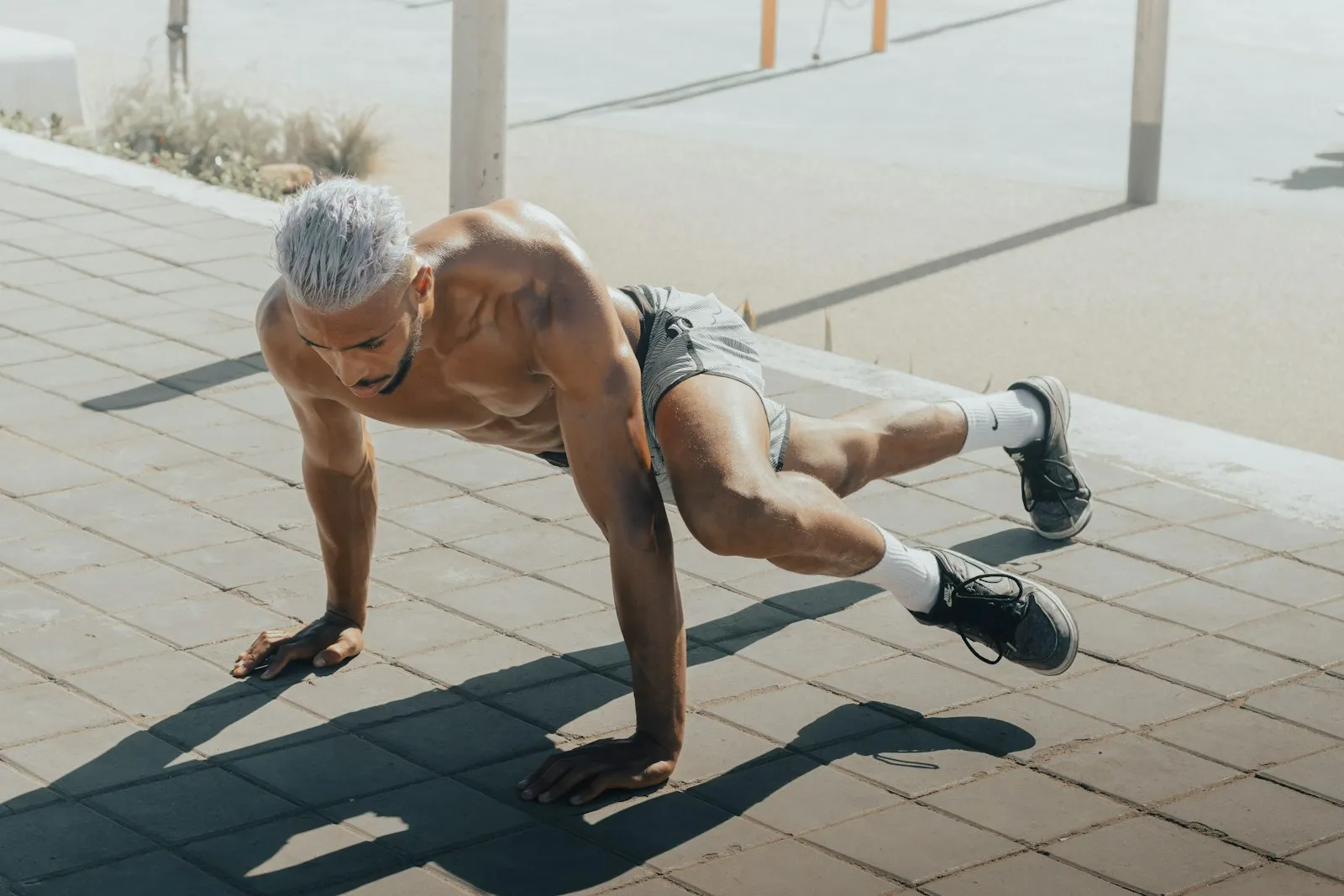
A complete calisthenics chest workout: the best bodyweight chest exercises for upper, middle and lower chest, routines by level, and how to keep progressing.
You don’t need a bench press to build a strong, full chest. Push-ups and dips load the same muscles, and when they’re done hard enough they produce the same kind of gains. Where most bodyweight chest training goes wrong is not the exercises; it’s doing the same 20 easy push-ups for months.
The short answer: a complete calisthenics chest workout combines a main push-up variation hard enough that you can only do about 5 to 15 reps (deficit, archer or weighted push-ups as you get stronger), dips if you have parallel bars, a decline push-up for the upper chest, and a finisher such as wide or tempo push-ups. Do 3 to 4 sets of each, two or three times a week, stopping each set 1 to 3 reps short of failure. When an exercise passes about 15 to 20 clean reps, move to a harder variation. No bars? Chairs, a table and a backpack are enough to train your chest seriously at home.
Below you’ll find which parts of the chest to cover, the best exercises from easiest to hardest, four complete routines (beginner, intermediate, advanced and no equipment) and the rules that keep your chest growing. If you’d rather not plan it all yourself, Titan Mode builds your weekly calisthenics sessions around your level and the equipment you have, push days included.
Can calisthenics build a big chest?
Yes, and this is one of the better-studied questions in bodyweight training.
- In a study of trained men, push-ups and the bench press performed at comparable levels of muscle activity (using elastic bands to make the push-up harder) produced similar strength gains over five weeks (Calatayud et al., 2015).
- In another study, eight weeks of low-load bench press or push-ups produced similar increases in chest muscle thickness and strength (Kikuchi & Nakazato, 2017).
- More broadly, a meta-analysis found that muscle growth is similar with light and heavy loads as long as sets are taken close to failure, while heavy loads still give more maximal strength (Schoenfeld et al., 2017).
So the limit isn’t the push-up itself. It’s how hard you make it. A full push-up moves roughly two thirds of your bodyweight; a decline, archer or weighted push-up moves considerably more, and dips move nearly all of it. That’s plenty of load for years of progress.
What calisthenics won’t do is let you add 2.5 kg every week. You progress by changing the leverage, the range of motion and the tempo, then by adding weight once the hardest variations get easy.
The parts of the chest a workout must cover
The pectoralis major is one big fan-shaped muscle, but its fibers run in different directions, and the angle of your arms changes which part works hardest:
| Area | What it does | Best calisthenics exercises |
|---|---|---|
| Upper chest (clavicular head) | Pushes forward and upward | Decline push-ups, pike-leaning push-ups |
| Middle chest (sternal head) | Pushes straight forward | Push-ups, deficit, archer and wide push-ups |
| Lower chest (costal fibers) | Pushes down and forward | Dips, incline push-ups |
| Supporting muscles | Front shoulders, triceps, serratus anterior | Every push-up and dip, plus push-up plus |
You can’t isolate one part of the chest completely, and you don’t need to. A workout that combines a horizontal push (push-ups), a downward push (dips or incline push-ups) and an upward-angled push (decline push-ups) trains the whole muscle.
Hand position matters more than many people think. In an EMG study, a narrower hand position increased chest and triceps activity compared with a shoulder-width base (Cogley et al., 2005). Very wide hands, on the other hand, shorten the range of motion for the chest and put more stress on the front of the shoulder. A good default: hands slightly wider than your shoulders, elbows about 30 to 45 degrees from your torso.
The best calisthenics chest exercises, from easiest to hardest
Pick exercises from your level, and move up a rung when you can do 3 sets of the top of the rep range with clean form. Our step-by-step push-up progression covers the early rungs in more detail.
Level 1: building the base
- Incline push-ups (hands on a table, a counter or a bench). The higher the hands, the easier it is. Lower the surface as you get stronger.
- Knee push-ups, with a straight line from knees to head. A good stepping stone if incline push-ups get easy before full push-ups are possible.
- Slow negatives: lower yourself from the top of a push-up in 3 to 5 seconds, then reset on your knees.
Level 2: the full push-up and its variations
- Standard push-ups: body in a straight line, chest touching the floor or a fist-height marker, full lockout at the top.
- Diamond or close-grip push-ups: hands close together. More triceps and inner chest; harder on the wrists for some people. If your goal is bigger arms, our calisthenics arm workout builds on this variation.
- Wide push-ups: hands about one and a half shoulder widths apart. A useful variation, not a main lift.
- Decline push-ups: feet on a chair or box. Shifts more of the work to the upper chest and front shoulders.
Level 3: harder leverage and more range
- Deficit push-ups: hands on two books, yoga blocks or push-up handles so your chest can sink lower than your hands. The extra stretch makes each rep harder.
- Dips on parallel bars or two stable chairs. Lean the torso slightly forward for more chest. Our dips progression takes you from support holds to your first full reps.
- Archer push-ups: one arm bends while the other slides out straight to the side. A bridge toward one-arm work.
- Pseudo planche push-ups: hands turned out by your hips, shoulders leaning well in front of the hands. Hard on the chest and front shoulders, and a classic step toward the planche.
Level 4: advanced
- Weighted push-ups with a loaded backpack or a plate on your upper back (with a partner placing it).
- Ring push-ups and ring dips: the instability makes the chest work harder to keep the rings close.
- Weighted dips with a backpack or a dipping belt.
- One-arm push-up progressions: incline one-arm push-ups first, then lower the surface.
If you’re also working toward vertical pressing, pike push-ups pair well with this list, though they train the shoulders far more than the chest. For complete routines that cover the front, side and rear of the shoulder, see our calisthenics shoulder workout.
Calisthenics chest workout routines by level
Rest about 1.5 to 2 minutes between sets of the main exercises and 60 to 90 seconds on the finishers. Stop each set when you have about 1 to 3 good reps left in you. Warm up first with arm circles, a set of easy incline push-ups and a few scapular push-ups.
Beginner chest workout (2 to 3 times a week)
| Exercise | Sets × reps |
|---|---|
| Incline push-ups (the lowest surface that allows 8 to 15 reps) | 3 × 8-15 |
| Push-up negatives, 3 to 5 seconds down | 3 × 4-6 |
| Knee push-ups or wide incline push-ups | 2 × 10-15 |
| Push-up plus (protract the shoulder blades at the top) | 2 × 10-12 |
Keep the same surface until you hit 3 × 15 with good form, then lower it. Most people reach their first sets of full push-ups within a few weeks to a few months this way.
Intermediate chest workout
| Exercise | Sets × reps |
|---|---|
| Deficit push-ups | 4 × 8-15 |
| Dips (bars or stable chairs) | 3 × 6-12 |
| Decline push-ups, feet on a chair | 3 × 8-15 |
| Diamond push-ups, 2 seconds down | 2 × 8-12 |
Advanced chest workout
| Exercise | Sets × reps |
|---|---|
| Weighted dips or ring dips | 4 × 5-10 |
| Archer push-ups (each side) or weighted push-ups | 4 × 5-10 |
| Pseudo planche push-ups | 3 × 6-10 |
| Ring push-ups or deficit push-ups to near failure | 2 × 10-20 |
No-equipment chest workout at home
| Exercise | Sets × reps |
|---|---|
| Push-ups with hands on two stacks of books (deficit) | 4 × 8-15 |
| Chair dips between two sturdy chairs set back to back | 3 × 6-12 |
| Decline push-ups, feet on the sofa or bed | 3 × 8-15 |
| Backpack push-ups (when bodyweight sets pass 20 reps) | 3 × 8-12 |
| Tempo push-ups: 3 seconds down, 1-second pause at the bottom | 2 × 6-10 |
Chairs must not tip or slide: test them with your full weight before you dip, and use the corner of a fixed kitchen counter instead if you have any doubt. For a complete program around these exercises, see our calisthenics workout at home with no equipment.
Where chest work fits in your week
You don’t need a separate “chest day”. The two simplest setups:
- Full body, 3 times a week: one chest exercise and one dip or decline variation in each session, alongside a pull, a leg exercise and core work. This is how our beginner calisthenics program is built.
- Push / pull / legs: chest, shoulders and triceps together on push days, twice a week, with your back on pull days. Pair this guide with our calisthenics back workout so pushing and pulling stay balanced, which matters for shoulder health.
Keeping the plan consistent from week to week is where most people slip. Titan Mode sequences your push, pull and leg sessions around your schedule, with guided sets and a rest timer, so you know what to do each time you train.
How to keep progressing
Muscle keeps growing when the work keeps getting harder. Use these levers in this order:
- Add reps within your target range (for example 8 to 15).
- Make the variation harder once you reach the top of the range on every set: incline → full → deficit → archer → weighted.
- Slow the tempo: three seconds down and a pause at the bottom make the same push-up much harder.
- Add sets: a dose-response meta-analysis found more growth with more weekly sets, up to around 10 or more per muscle per week (Schoenfeld, Ogborn & Krieger, 2017). Build up gradually rather than doubling overnight.
- Add weight: a backpack with books or water bottles, a weight vest or a dipping belt.
Keep a simple log of the variation, sets and reps for each session. Without one, it’s very easy to repeat the same workout for months without noticing that nothing is moving. This “double progression” (reps first, then difficulty) is also what the American College of Sports Medicine recommends in its resistance-training guidelines.
How fast should you expect to see a bigger chest? Strength usually rises within weeks, but visible size takes months and depends heavily on eating enough protein and calories. Our guide on how much muscle you can build in a year gives realistic numbers.
Common mistakes in a bodyweight chest workout
- Staying on easy push-ups. Sets of 40 or 50 reps build endurance more than size. Move to a harder variation instead.
- Half reps. Stopping halfway down cuts out the part of the movement where the chest is most stretched. Go all the way down, or use a marker such as a fist or a foam block.
- Flared elbows. Elbows at 90 degrees from the body put strain on the front of the shoulder. Tuck them to about 30 to 45 degrees.
- Sagging hips. If your hips drop, your core gives out before your chest. Squeeze your glutes and brace as in a hollow body hold, or regress the variation.
- Dips too deep, too soon. Going far below the point where your upper arm is parallel to the floor stresses the shoulder. Build depth gradually.
- Only pushing. Lots of push-ups with little pulling tends to pull the shoulders forward. Match your pushing sets with rows and pull-ups.
Safety and limits
- Wrists: if push-ups hurt your wrists, use push-up handles, fists or dumbbells to keep the wrists straight, and warm them up with gentle circles and rocking.
- Shoulders: a pinching pain at the front of the shoulder during dips or deep push-ups is a sign to reduce depth or switch to an easier variation. Sharp pain or pain that lasts after training deserves a visit to a health professional.
- Sternum and elbows: deep or weighted dips can irritate the sternum or the elbows if you add load too quickly. Increase weight in small steps.
- Equipment at home: only use furniture that can’t tip or slide, and never dip on folding chairs.
If you have a shoulder injury, high blood pressure or another health condition, check with your doctor before starting heavy pushing work.
Putting it into practice
Pick the routine that matches your level, run it two or three times a week for six to eight weeks, and log every session. Each time a set reaches the top of its rep range, make the exercise a little harder. That’s all a calisthenics chest workout needs: the right exercises, enough effort and steady progression. If you want those steps planned for you, download Titan Mode and get a calisthenics plan built around your week and your equipment.
This article is general information, not medical advice. If you have a medical condition, an injury, pain or are pregnant, talk to a health professional before changing your training or diet.
FAQ
Can you build a big chest with calisthenics?
Yes. Studies comparing push-ups and the bench press at similar effort found similar gains in chest muscle size and strength. The key is to keep making the exercise harder (deficit, archer, decline and weighted push-ups, then dips) and to take your sets close to failure, rather than adding endless easy reps.
What is the best calisthenics exercise for the chest?
Push-ups and dips. Push-ups are the most scalable chest exercise there is, from incline to archer and weighted versions. Dips load the lower chest and triceps with close to your full bodyweight. A good chest workout uses both if you have parallel bars, and push-up variations only if you don't.
How do I target my upper chest with calisthenics?
Raise your feet. Decline push-ups, with your feet on a chair or bench, put more of the work on the upper chest and front shoulders. The higher the feet, the more the movement shifts toward the shoulders, so a box or chair at about knee height is a good place to start.
How do I train the lower chest without equipment?
Dips are the main lower-chest exercise. Without bars, use two sturdy chairs placed back to back or the corner of a kitchen counter, only if they are completely stable. Incline push-ups with your hands on a table also place more of the work on the lower part of the chest.
How many times a week should I train chest with calisthenics?
Two to three times a week works for most people, inside full-body or push sessions. Aim for roughly 10 to 20 hard sets of pushing work per week in total, starting near the lower end if you're new.
How many push-ups a day to build a bigger chest?
A daily number isn't what builds muscle. Two or three sessions a week of 3 to 5 hard sets, with the last reps feeling difficult, works better than hundreds of easy reps. Once you can do more than about 20 to 25 clean push-ups, switch to a harder variation.
Sources
- Calatayud J. et al. (2015). Bench press and push-up at comparable levels of muscle activity results in similar strength gains. J Strength Cond Res.
- Kikuchi N., Nakazato K. (2017). Low-load bench press and push-up induce similar muscle hypertrophy and strength gain. J Exerc Sci Fit.
- Cogley R.M. et al. (2005). Comparison of muscle activation using various hand positions during the push-up exercise. J Strength Cond Res.
- Schoenfeld B.J. et al. (2017). Strength and hypertrophy adaptations between low- vs. high-load resistance training: a systematic review and meta-analysis. J Strength Cond Res.
- Schoenfeld B.J., Ogborn D., Krieger J.W. (2017). Dose-response relationship between weekly resistance training volume and increases in muscle mass: a systematic review and meta-analysis. J Sports Sci.
- American College of Sports Medicine (2009). Position stand: progression models in resistance training for healthy adults. Med Sci Sports Exerc.